Introduction
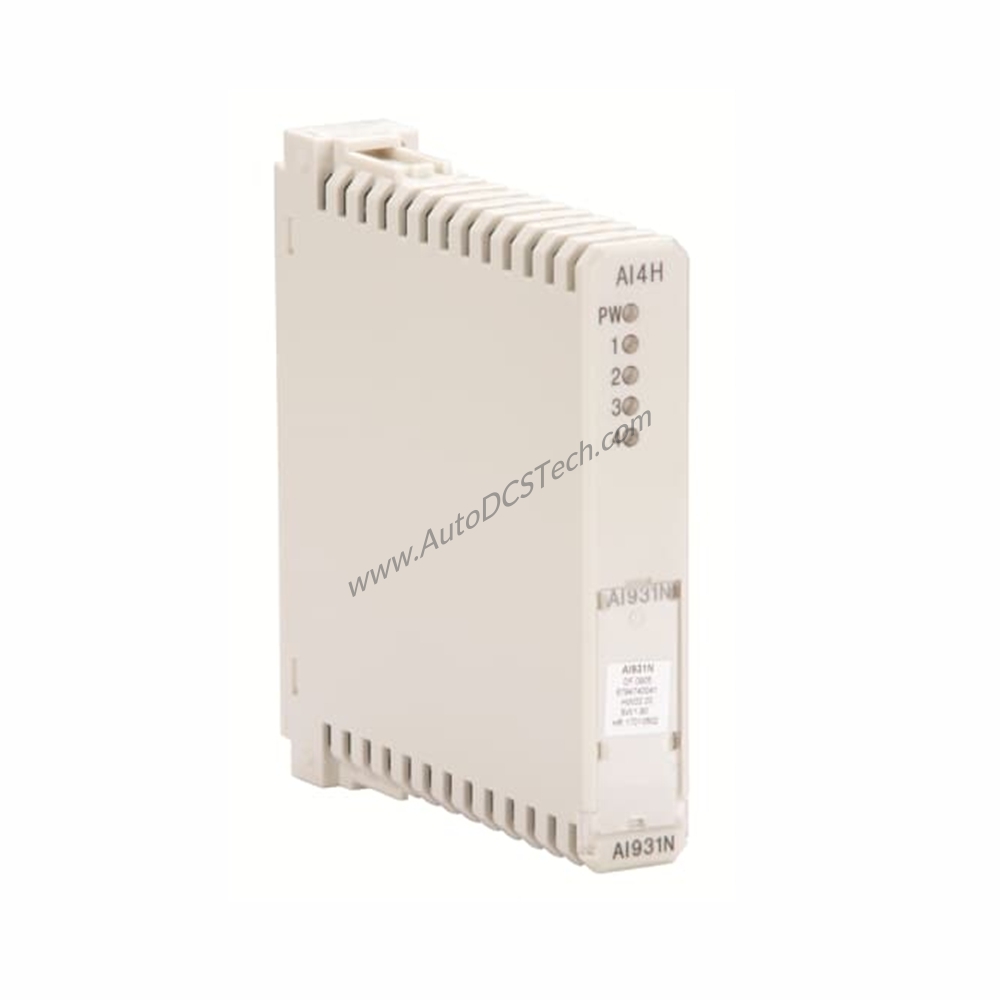
In the evolving landscape of industrial automation, remote terminal units (RTUs) have become essential for monitoring and controlling distributed assets. The ABB RTU560 560AIR02 analog input module exemplifies this progress, offering precise measurement capabilities for demanding applications. As part of the RTU560 product line, this module records up to 8 analog measured values, processing signals like analog measured values (AMI) and measured floating point information (MFI).
Technical Specifications Breakdown
High-Resolution 16-Bit ADC
The 560AIR02 features a 16-bit AD converter, enabling high-resolution scanning across all measuring ranges. This ensures consistent accuracy whether you measure ±2 mA or ±40 mA. An internal channel performs automatic zero calibration to compensate for long-term component drift, maintaining reliability over time.
Configurable Measuring Ranges
You can configure five current ranges: ±2 mA, ±5 mA, ±10 mA, ±20 mA, and ±40 mA. Other input ranges and live zero values are generated by conversion on the communication unit (CMU). The RTUtil500 configuration tool simplifies setup for measuring range and line frequency.
Line Frequency Synchronization
The module synchronizes its scan cycle with line frequencies of 60 Hz, 50 Hz, or 16.7 Hz to enhance interference suppression. For 60 Hz and 50 Hz, conversion time per channel is 54 ms with a scan cycle time of 486 ms. At 16.7 Hz, conversion time extends to 155 ms with a 1395 ms scan cycle.
Industry Applications
The 560AIR02 excels in scenarios requiring precise analog input monitoring. In power distribution networks, it measures current signals from transducers to track load conditions. In water treatment facilities, it monitors flow or pressure transmitters, providing data for process control. Its differential inputs and over-voltage protection suit harsh industrial environments.
Installation & Setup Guidance
Mount the module securely in the RTU560 chassis. Connect differential input signals using shielded twisted-pair cables to minimize noise. Configure the measuring range and line frequency via RTUtil500 before commissioning. Ensure the power supply is galvanically isolated as the inputs share a common connection with the supply.
Maintenance & Reliability
Regularly inspect the module for signs of environmental stress. The built-in low-pass filter and over-voltage protection reduce wear from electrical disturbances. Automatic zero calibration minimizes drift, extending calibration intervals. For long-term reliability, verify that the operating environment stays within specified conditions.
Compatibility & Integration
The 560AIR02 integrates seamlessly with the ABB RTU560 product line. It communicates via the RTU I/O bus, transmitting relevant changes as events to unburden the communication unit. This design supports efficient data handling in distributed control systems.
Selection Guide & Purchasing Advice
Before ordering, confirm that your system uses the RTU560 platform and requires 8 analog input channels with current ranges up to ±40 mA. The module processes differential inputs with 16-bit resolution. For availability and lifecycle status, contact SpareTechPLC, a trusted supplier of industrial automation parts.
Frequently Asked Questions
Q: What is the resolution of the 560AIR02?
A: The module uses a 16-bit AD converter, resolving single-ended or differential inputs into up to 4096 steps (12 bit plus sign) for 100% measurement amplitude.
Q: Can I measure voltage with this module?
A: The 560AIR02 is designed for current inputs only, with ranges from ±2 mA to ±40 mA. Voltage measurements require external conversion.
Q: How do I configure the measuring range?
A: Use the RTUtil500 configuration tool to select the desired range and line frequency. The module synchronizes its scan cycle for optimal interference rejection.
Q: What is the scan cycle time at 50 Hz?
A: At 50 Hz, conversion time per channel is 54 ms, and the scan cycle time for all channels is 486 ms.
Q: Does the module support differential inputs?
A: Yes, the 8 inputs are differential and galvanically connected to the power supply, with protection against over-voltages.