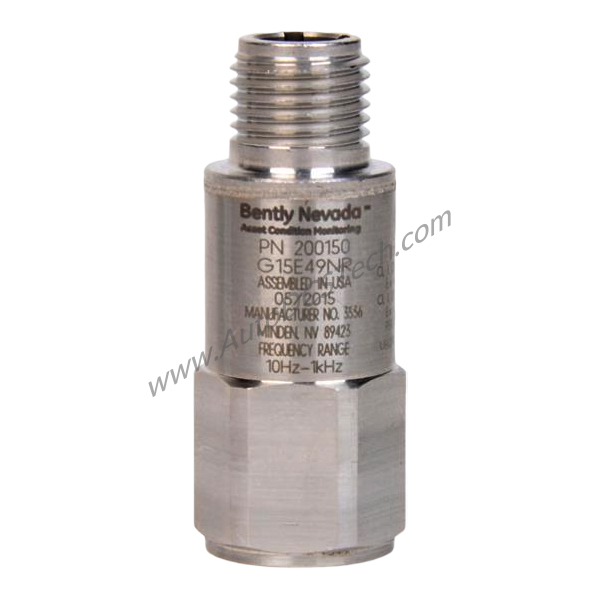
Technical Specifications Breakdown
The 200157-22-05 offers a sensitivity of 10.2 mV/(m/s²) (100 mV/g) at 80 Hz with ±12% tolerance, ensuring accurate vibration measurement. Its measurement range spans ±245 m/s² (±25 g), covering typical machinery vibration levels. The frequency response extends from 10 to 10,000 Hz (600 to 600,000 cpm), referenced to 80 Hz, making it suitable for monitoring high-speed rotating equipment. Mounted resonant frequency exceeds 20 kHz (>1200 kcpm), and amplitude linearity stays within ±2% from 1 to 10 g peak. Transverse sensitivity is ≤7%, minimizing cross-axis errors.
Electrical characteristics include an excitation voltage of 4.7 to 5.5 Vdc, quiescent current below 800 µA, and output bias voltage of +2.5 ± 0.23 Vdc. Settling time is ≤300 ms. The accelerometer uses a ceramic shear sensing element with 316L stainless steel housing and connector material (200155).
Industry Applications
Its high-frequency range and enveloping capability allow early identification of bearing defects before catastrophic failure. For example, in a paper mill, the 200157-22-05 can track bearing condition on dryer rolls, reducing unplanned downtime. The multiple approvals (CSA, ATEX, and IECEx) enable use in hazardous areas.
Installation & Setup Guidance
Mount the 200157-22-05 using the 3/8-24 female thread. Apply mounting torque between 2.7 to 6.8 N•m (2 to 5 ft•lbf). The mounting stud option 22 includes a 3/8-24 to M8x1.25 1-3/8 inch hex plate stud. Ensure the mounting surface is clean and flat for optimal coupling. Allow 24 hours cure time if using adhesive. Connect to a ProTIM option with standard acceleration-to-velocity and acceleration enveloping channel type (-06).
Maintenance & Reliability
With a temperature range of -40 °C to +105 °C (-40 °F to +221 °F) and hermetic sealing (5x10⁻⁸ atm•cc/s max), this sensor withstands harsh conditions. Axial shock limit is 49,050 m/s² pk (5,000 g pk). Relative humidity tolerance is 100% condensing, non-submerged. Periodic inspection of the cable and connector ensures reliable data transmission. The stainless steel construction resists corrosion in wet environments.
What Is the Bently Nevada 200157-22-05 Enveloping Trendmaster Pro?
When roller element bearings fail unexpectedly, production halts and costs escalate. The Bently Nevada 200157-22-05 Enveloping Trendmaster Pro accelerometer delivers precise vibration data to detect early signs of bearing wear and cavitation. This sensor, manufactured in the U.S.A., is part of the Trendmaster Pro family and is designed for continuous condition monitoring in harsh industrial environments.
Compatibility & Integration
The 200157-22-05 works with Bently Nevada monitoring systems that accept accelerometer inputs. It is specifically used with the ProTIM option for enveloping and acceleration-to-velocity processing. Verify system compatibility before ordering. The sensor outputs a positive signal (SIG+ positive with respect to SIG-) for acceleration from base to connector.
Selection Guide & Purchasing Advice
Before purchasing, confirm your system requires the 200157-22-05 Enveloping Trendmaster Pro accelerometer. Check the mounting thread (3/8-24 female) and approvals needed (05 = multiple approvals). AutoDCSTech stocks this model and can assist with availability and lifecycle status. Please verify current lifecycle status and availability with AutoDCSTech before ordering.
Frequently Asked Questions
What is the sensitivity of the 200157-22-05?
The sensitivity is 10.2 mV/(m/s²) (100 mV/g) at 80 Hz, with ±12% tolerance.
What is the measurement range?
The accelerometer measures ±245 m/s² (±25 g) peak.
What temperature range can it withstand?
Operating temperature range is -40 °C to +105 °C (-40 °F to +221 °F).
What approvals does it have?
It carries multiple approvals: CSA, ATEX, and IECEx (approval code 05).
What type of bearing monitoring is it best for?
It is designed for roller element bearing monitoring and detecting cavitation effects.
Availability & Condition at AutoDCSTech
| Part Number | 200157-22-05 |
|---|---|
| Availability | In Stock |
| Condition | New |
| Warranty | One Year |
| Origin | US |