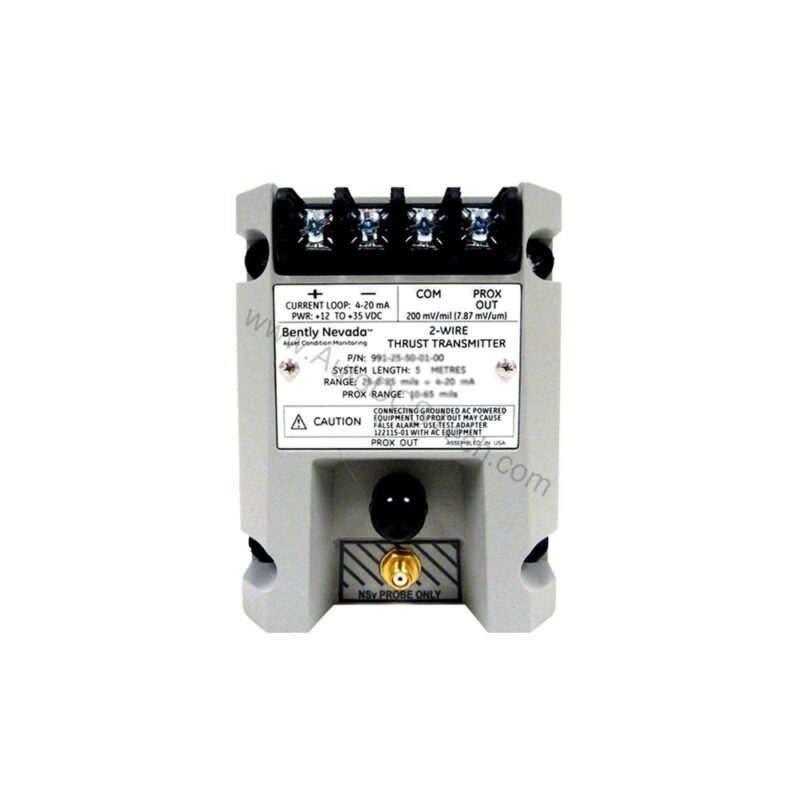
991-25-50-02-00 Overview: Precision Axial Thrust Monitoring
When machinery protection demands reliable axial position measurement, the 991-25-50-02-00 from Bently Nevada delivers a robust solution. This probe vibration transmitter converts proximity probe signals into a standard 4-20 mA current loop, enabling seamless integration with PLCs, DCS, and SCADA systems. Its compact DIN-rail mount simplifies installation in existing panels, while the 25-0-25 mils full-scale range matches common thrust bearing applications.
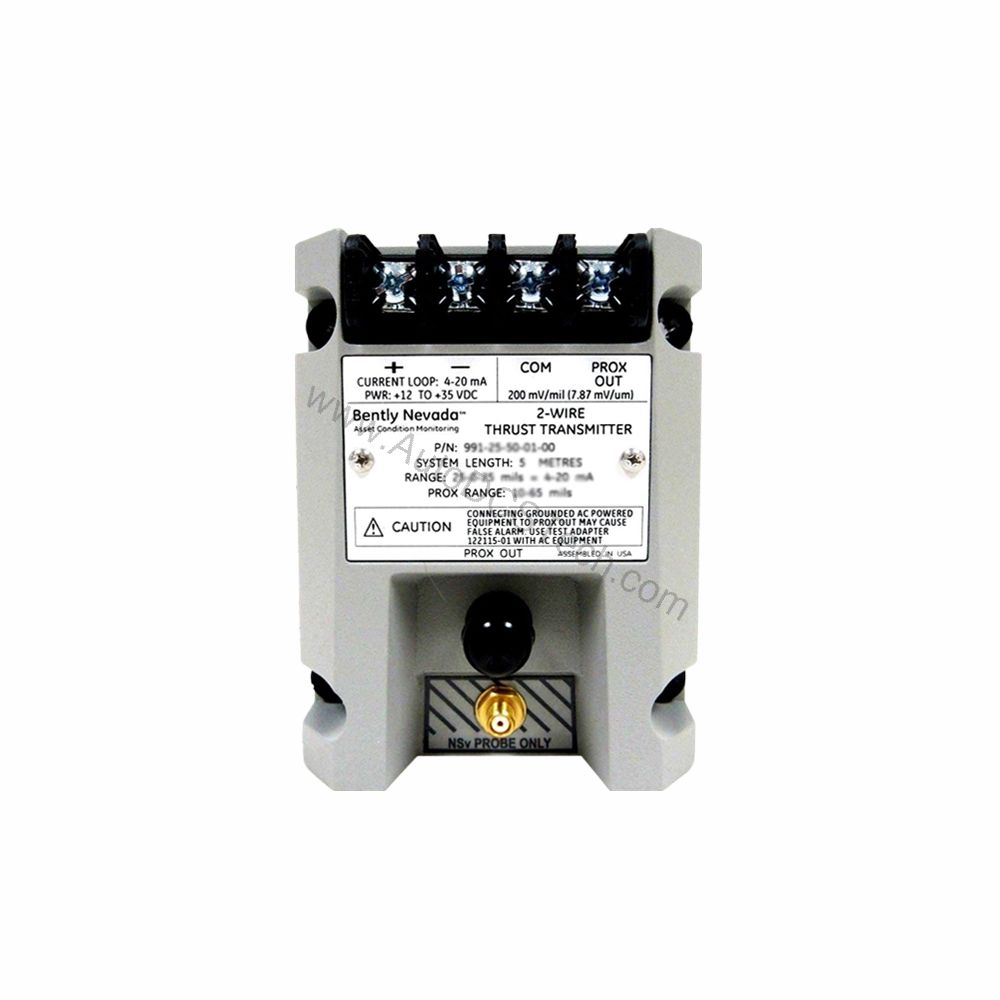
Key Features and Technical Specifications
The 991-25-50-02-00 is engineered for continuous operation in harsh industrial environments. Its key parameters include:
- Full-scale range: 25-0-25 mils (0.6-0-0.6 mm) for axial displacement.
- System length: 5.0 meters (16.4 feet) probe and extension cable.
- Output: 4-20 mA DC, two-wire configuration, over the specified full-scale range.
- Power: +12 to +35 Vdc input at the transmitter terminal.
- Linear range: 0.25 to 1.65 mm for Prox Out, suitable for 0.6-0-0.6 mm or 25-0-25 mils current loop linear ranges.
- Operating temperature: -35°C to +85°C (-31°F to +185°F).
- Storage temperature: -51°C to +100°C (-60°F to +212°F).
- Weight: 0.43 kg (0.9 lbm).
One distinctive feature is the Not OK/Signal Defeat function. When a fault condition occurs, the output drops to less than 3.6 mA within 100 microseconds, alerting control systems immediately. This fast response helps prevent costly damage from undetected probe failures.
Applications and Use Cases
The 991-25-50-02-00 is specifically designed for axial thrust monitoring in turbomachinery, compressors, and large pumps. Its 4-20 mA output makes it ideal for retrofitting older systems that lack proprietary communication protocols. For example, a plant engineer can replace an outdated vibration monitor with this transmitter, connecting directly to a PLC analog input for continuous thrust position data. This simplifies wiring and reduces spare parts inventory.
Installation and Setup
Mounting the 991-25-50-02-00 is straightforward. It clips onto a standard DIN rail, and the bulkhead screw mounting option secures the probe cable entry. The transmitter accepts one non-contacting 3300 NSv proximity probe and extension cable. Ensure the system length matches the 5.0-meter requirement to maintain calibration. Power and output connections use a two-wire loop; verify the loop resistance does not exceed 1,000 ohms at 35 Vdc to maintain accuracy.
Maintenance and Reliability
Routine maintenance is minimal. Periodically inspect the DIN-rail connection and probe cable for physical damage. Check that the transmitter's operating environment stays within the -35°C to +85°C range. The non-interacting zero and span adjustments allow quick recalibration without disturbing the other. Because the unit is solid-state, there are no moving parts to wear out, contributing to long service life.
Troubleshooting and Common Issues
If the output current falls below 3.6 mA, the transmitter is in a Not OK state. This could indicate a probe fault, cable break, or power supply issue. Verify the input voltage is between +12 and +35 Vdc. Also, confirm the loop resistance is within the 1,000-ohm limit. For persistent problems, consult the Bently Nevada manual or contact AutoDCSTech for technical support.
Compatibility and Integration
The 4-20 mA output is universally accepted by most control systems, making the 991-25-50-02-00 highly compatible. It works with any PLC or DCS analog input card that accepts 4-20 mA signals. The two-wire configuration simplifies field wiring, reducing installation time and potential errors.
Product Support and Availability
The 991-25-50-02-00 is available from AutoDCSTech. Contact us for current pricing and lead times. Our team can assist with technical questions and ordering information.