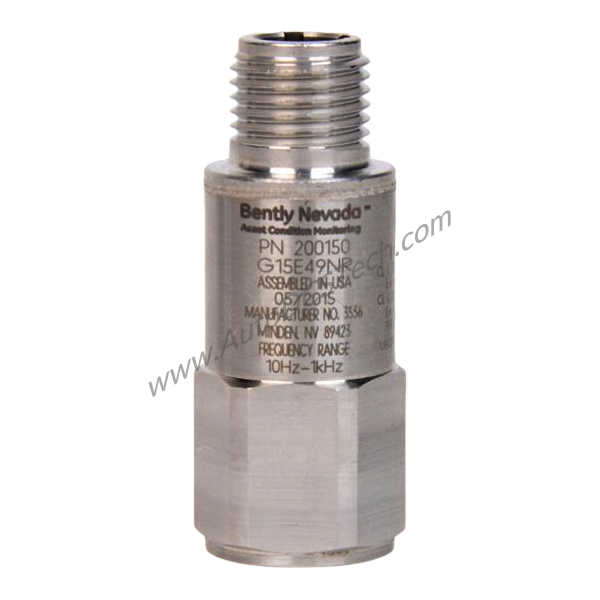
Product Overview
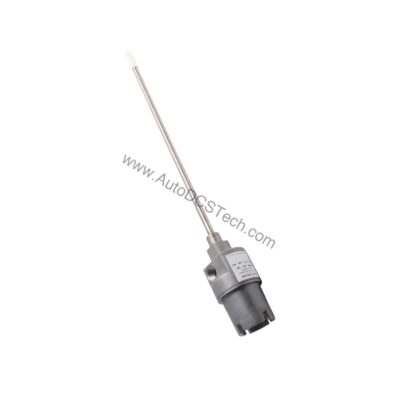
When unexpected bearing failures halt production, the Bently Nevada 200157-10-05 Enveloping Trendmaster Pro accelerometer provides the early warning your facility needs. This sensor targets roller element bearing degradation and certain cavitation effects, helping you avoid costly unplanned downtime. By detecting subtle vibration changes before catastrophic failure, the 200157-10-05 reduces repair costs and extends equipment life.
Technical Specifications Breakdown
Sensitivity and Range
The 200157-10-05 delivers a sensitivity of 10.2 mV/(m/s²) at 80 Hz, with a measurement range of ±245 m/s². This combination captures both low-level bearing wear signals and higher amplitude events, allowing precise condition monitoring without sensor saturation. The frequency range spans 10 to 10,000 Hz, covering the critical spectrum for rolling element bearings.
Environmental Durability
With a temperature range of -40 °C to +105 °C and 100% relative humidity tolerance, this accelerometer performs reliably in harsh industrial environments. The hermetic sealing (5×10⁻⁸ atm•cc/s maximum) prevents moisture ingress, reducing replacement frequency and associated labor costs.
Physical Construction
The 316L stainless steel housing and ceramic shear sensing element resist corrosion and mechanical stress. Weighing just 58 g, the 200157-10-05 minimizes mass loading on the measurement point. The 3/8-24 female mounting thread and recommended torque of 2.7 to 6.8 N•m ensure consistent coupling.
Industry Applications
Paper Mills
In paper mill dryer sections, high humidity and heat accelerate bearing wear. The 200157-10-05's sealed construction and wide temperature range allow continuous monitoring in these conditions. Early detection of bearing defects reduces emergency shutdowns and maintenance overtime costs.
Chemical Processing
Chemical plants face corrosive atmospheres and cavitation in pumps. The 316L stainless steel housing resists chemical attack, while the accelerometer's sensitivity to cavitation effects enables proactive maintenance scheduling. This extends pump seal and bearing life, lowering total cost of ownership.
Installation & Setup Guidance
Mount the 200157-10-05 using the 3/8-24 female thread onto a clean, flat surface. Apply the specified mounting torque of 2.7 to 6.8 N•m to ensure proper mechanical coupling. Allow 24 hours cure time if using adhesive mounting. Connect the accelerometer to a compatible ProTIM option with standard acceleration-to-velocity and acceleration enveloping channel type. The excitation voltage range is 4.7 to 5.5 Vdc.
Maintenance & Reliability
Periodically inspect the mounting integrity and cable connections. The hermetically sealed design requires no internal maintenance, reducing lifecycle costs. Verify output bias voltage remains within +2.5 ± 0.23 Vdc during routine checks. The 200157-10-05's robust construction minimizes replacement frequency, delivering long-term value.
Selection Guide & Purchasing Advice
Before ordering, confirm your application requires the Enveloping Trendmaster Pro with multiple approvals (CSA, ATEX, and IECEx). The mounting stud option 10 (3/8-24 to 1 NPT, 1-3/8 inch hex stud) is included. AutoDCSTech stocks the 200157-10-05 and can verify current lifecycle status and availability. Contact our team for assistance matching this accelerometer to your monitoring system.
What is the measurement range of the 200157-10-05?
The accelerometer measures ±245 m/s² with a sensitivity of 10.2 mV/(m/s²) at 80 Hz.
What temperature range does this accelerometer support?
It operates from -40 °C to +105 °C, suitable for demanding industrial environments.
What mounting thread does the 200157-10-05 use?
The sensor features a 3/8-24 female mounting thread with a recommended torque of 2.7 to 6.8 N•m.
Is the 200157-10-05 suitable for hazardous areas?
Yes, this model includes multiple approvals: CSA, ATEX, and IECEx for use in classified locations.
What is the typical application for this accelerometer?
It is designed for monitoring roller element bearings and detecting certain cavitation effects in rotating machinery.
Availability & Condition at AutoDCSTech
| Part Number | 200157-10-05 |
|---|---|
| Availability | In Stock |
| Condition | New |
| Warranty | One Year |
| Origin | US |