Introduction: The Evolution of Vibration Monitoring
Industrial vibration monitoring has evolved from simple mechanical switches to sophisticated electronic transmitters. The 990-10-50-01-00 represents this modern approach. It converts raw proximity probe data into a standard 4-20 mA signal. This signal integrates seamlessly with existing control systems. The result is continuous, real-time machinery health data.
This Bently Nevada transmitter is designed for rotating equipment. It accepts one non-contacting 3300 NSv Proximity Probe. The probe measures shaft vibration directly. This method is proven and widely accepted in the industry. The transmitter processes the signal and outputs a loop current. This current is proportional to the vibration amplitude.
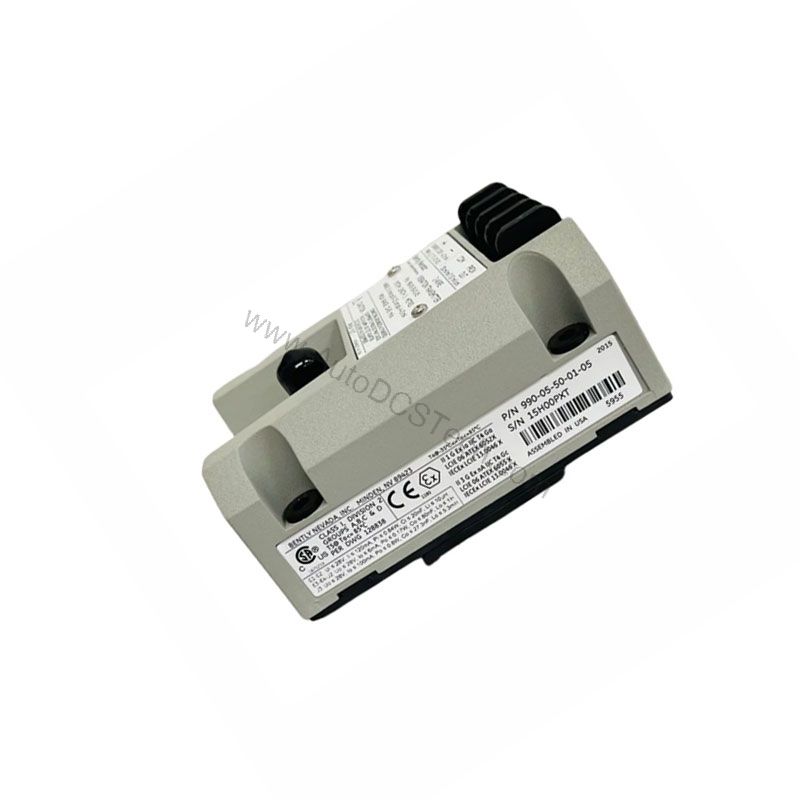
Key Features and Technical Specifications
The 990-10-50-01-00 offers a full-scale range of 0-10 mils pp (0-250 μm pp). This range is suitable for many industrial machines. The system length option is 5.0 meters (16.4 feet). This provides flexibility in probe placement. The mounting option is 35 mm DIN rail clips, simplifying installation in standard cabinets.
- Input: Accepts 1 non-contacting 3300 NSv Proximity Probe and extension cable.
- Power: Requires +12 to +35 Vdc input at the transmitter terminal.
- Output: 4 to 20 mAdc over specified full-scale range in 2-wire configuration.
- Accuracy: Within ±1.5% over specified full-scale range.
- Maximum Loop Resistance: 1,000 Ω including cable at 35 Vdc.
- Current Limiting: 23 mA typical.
- Frequency Response: 5 Hz to 6,000 Hz +0, 3 dB.
- Minimum Target Size: 9.5 mm (0.375 in) diameter.
- Probe Gap: Must be gapped between 0.5 and 1.75 mm (20 and 55 mils).
One distinctive spec is the frequency response. It covers 5 Hz to 6,000 Hz. This wide range captures both low-speed and high-speed machine vibrations. It ensures you do not miss critical fault frequencies. This makes the transmitter versatile across different equipment types.
Real-World Applications
This vibration transmitter is ideal for monitoring pumps, motors, fans, and compressors. In these applications, unbalance or misalignment causes vibration. The 990-10-50-01-00 detects these changes early. It provides a continuous signal to the control room. Operators can then schedule maintenance before failure occurs. This proactive approach reduces unplanned downtime.
Furthermore, the transmitter is suitable for hazardous area locations. It is rated for NonHazardous, Zone 2 or Div 2 areas. This expands its use in many process plants. The power supply requirement is 28 V. This is a common voltage in industrial loops.
Installation and Setup
Mounting the 990-10-50-01-00 is straightforward. Use the 35 mm DIN rail clips. Ensure the probe is correctly gapped. The gap must be between 0.5 and 1.75 mm. This is critical for accurate readings. Connect the probe and extension cable. Then wire the loop to the power supply. The transmitter requires +12 to +35 Vdc. Finally, adjust zero and span using the non-interacting external adjustments.
For optimal performance, verify the loop resistance. It must not exceed 1,000 Ω at 35 Vdc. This includes cable resistance. If the resistance is too high, the loop may not function correctly. Always follow the manufacturer's wiring diagram.
Maintenance and Reliability
Regular inspection is key to reliable operation. Check all connections periodically. Ensure the probe gap remains within specification. Verify the loop current is within the expected range. The transmitter is designed for long-term service. Its solid-state construction has no moving parts. This reduces wear and tear. Consequently, maintenance is minimal.
When a Not OK condition occurs, the signal output drops. It goes to less than 3.6 mA within 100 µs. This fast response alerts operators immediately. Once the condition is removed, the signal restores within 2-3 seconds. This automatic recovery minimizes downtime.
Compatibility and Integration
The 4-20 mA output is universally accepted. It connects directly to PLCs, DCS, and SCADA systems. No special interface is required. The transmitter operates in a 2-wire configuration. This simplifies wiring and reduces installation cost. It is compatible with standard loop-powered devices.
For existing Bently Nevada systems, this transmitter integrates easily. It uses the same 3300 NSv probe technology. This ensures consistency across your monitoring network. The leadwire length for the Proximitor Sensor Output is limited. Maximum cable distance is 3 meters (10 feet). Plan your installation accordingly.
Troubleshooting Common Issues
If the output is not as expected, check the probe gap first. An incorrect gap will affect the full-scale range. Next, verify the loop resistance. High resistance can cause errors. Also, confirm the power supply voltage. It must be between +12 and +35 Vdc. If the signal is stuck at a low value, check for a Not OK condition. The transmitter indicates this by dropping below 3.6 mA.
If the signal is noisy, inspect the probe and cable. Ensure they are properly shielded and grounded. Also, check the target size. It must be at least 9.5 mm in diameter. A smaller target may cause erratic readings.
Product Support and Availability
The 990-10-50-01-00 is available from AutoDCSTech. We are an industrial automation parts supplier. Contact us for current availability and lifecycle status. We can help you source this vibration transmitter. Ensure your machinery monitoring system operates reliably.