Introduction: The Evolution of Vibration Monitoring
For decades, industrial plants have relied on vibration monitoring to protect rotating machinery. Early systems used simple switches that only triggered on severe faults. Over time, the industry demanded continuous, precise data. The 990-10-70-03-01 from Bently Nevada represents this evolution. It delivers a standardized 4-20 mA signal that integrates directly with modern control systems.
This transmitter accepts one non-contacting 3300 NSv proximity probe. It converts the probe's dynamic motion into a proportional current loop signal. Consequently, operators gain real-time insight into machine health without complex standalone systems.
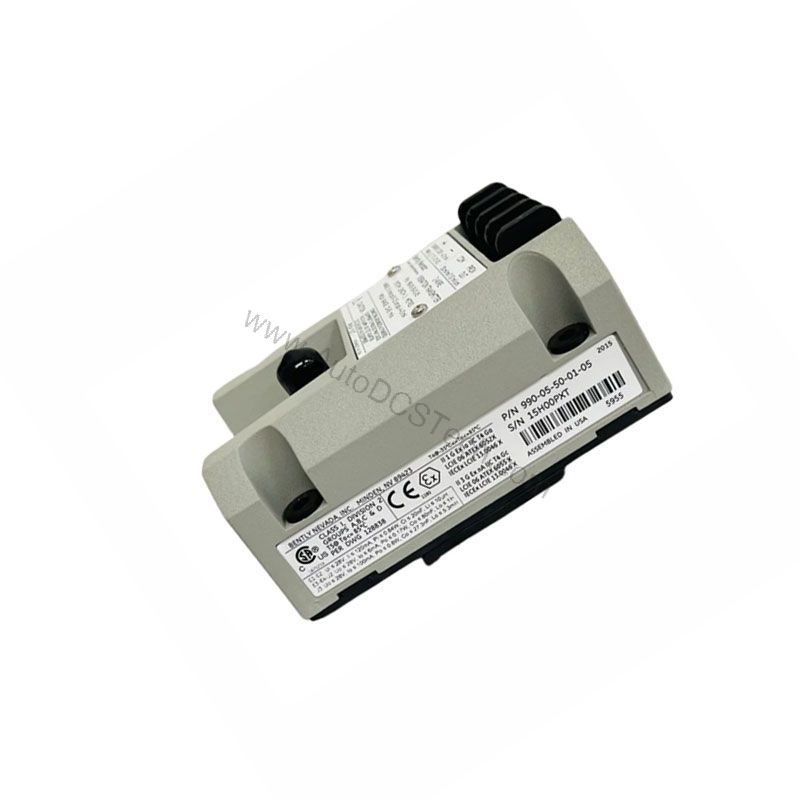
Key Features and Technical Specifications of the 990-10-70-03-01
The 990-10-70-03-01 offers a robust set of features tailored for continuous vibration monitoring. Its design focuses on accuracy, reliability, and ease of integration.
- Full-Scale Range: 0-10 mils pp (0-250 μm pp) – selectable via the '10' option.
- System Length: 7.0 meters (23.0 feet) – the '70' option defines the total cable run.
- Mounting: DIN clips and screws – the '03' option simplifies panel installation.
- Agency Approval: CSA Division 2 – suitable for non-hazardous, Zone 2 or Div 2 areas.
- Input: Accepts one 3300 NSv proximity probe and extension cable.
- Power Requirement: +12 to +35 Vdc at the transmitter terminal.
- Output: 4 to 20 mAdc over the full-scale range in a 2-wire configuration.
- Accuracy: Within ±1.5% over the full-scale range, measured from the TEST signal to the voltage across a 250 Ω loop resistance.
- Maximum Loop Resistance: 1,000 Ω including cable at 35 Vdc.
- Current Limiting: 23 mA typical.
- Frequency Response: 5 Hz to 6,000 Hz +0, 3 dB.
- Minimum Target Size: 9.5 mm (0.375 in) diameter.
- Leadwire Length: Maximum 3 meters (10 feet) for the Proximitor Sensor Output (BNC connector).
One distinctive feature is the NOT OK/signal defeat function. If a fault occurs, the output drops to less than 3.6 mA within 100 µs. This rapid response ensures that control systems immediately recognize a problem, enhancing overall safety.
Applications and Use Cases
The 990-10-70-03-01 is ideal for monitoring critical rotating equipment. Typical applications include pumps, motors, fans, and compressors. In these environments, continuous vibration data helps predict bearing wear and misalignment. Consequently, maintenance teams can schedule repairs before catastrophic failure occurs.
For example, in a chemical plant, a cooling water pump might experience progressive bearing degradation. The transmitter's 4-20 mA output feeds directly into a PLC or DCS. The control system can then trigger alarms or initiate shutdown sequences based on vibration thresholds. This proactive approach minimizes unplanned downtime and extends equipment life.
Installation and Setup
Proper installation is critical for accurate readings. The probe must be gapped between 0.5 and 1.75 mm (20 and 55 mils) from the target. This gap ensures the full-scale range is achievable. Use the provided DIN clips and screws for secure mounting.
Wire the transmitter in a 2-wire configuration. Connect the power supply (+12 to +35 Vdc) and the 4-20 mA loop. Ensure the loop resistance does not exceed 1,000 Ω at 35 Vdc. For longer cable runs, verify the total resistance stays within this limit.
After installation, perform a gap adjustment using the non-interacting external zero and span controls. These adjustments allow fine-tuning without affecting the other parameter. Always follow the manufacturer's manual for detailed procedures.
Maintenance and Reliability
Routine inspection is essential for long-term reliability. Periodically check the probe gap and cable connections. Verify that the mounting hardware remains tight. Clean the probe face gently if contamination is suspected, but avoid abrasive materials.
The transmitter's solid-state design has no moving parts, reducing wear. However, environmental factors like temperature and vibration can affect performance. Therefore, inspect the unit regularly as part of your preventive maintenance program.
Because the 990-10-70-03-01 is designed for continuous operation, it helps reduce downtime. Its fast NOT OK response (less than 3.6 mA within 100 µs) ensures that any malfunction is immediately visible to the control system. This early warning capability is a key reliability benefit.
Compatibility and Integration
The 990-10-70-03-01 integrates seamlessly with existing automation systems. Its 4-20 mA output is universally accepted by PLCs, DCSs, and SCADA systems. The 2-wire configuration simplifies wiring and reduces installation costs.
The transmitter accepts a standard 3300 NSv proximity probe. This compatibility allows easy retrofitting into existing Bently Nevada monitoring systems. For new installations, the complete system includes the probe, extension cable, and transmitter.
No special communication protocols are required. The analog signal is directly proportional to vibration amplitude. Therefore, integration is straightforward and does not require additional converters or gateways.
Troubleshooting and Common Issues
If the output signal is missing or incorrect, check the power supply first. Ensure the voltage is within +12 to +35 Vdc at the transmitter terminals. Next, verify the loop resistance. If it exceeds 1,000 Ω, the signal may be degraded.
Another common issue is improper probe gap. If the gap is outside the 0.5 to 1.75 mm range, the output may not reflect true vibration. Re-gap the probe according to the manual.
If the output goes below 3.6 mA, the NOT OK function may be active. This indicates a fault condition. Check the probe and cable for damage. Once the fault is cleared, the output should restore within 2-3 seconds.
For persistent issues, consult the official Bently Nevada documentation or contact AutoDCSTech for technical support.
Product Support and Availability
The 990-10-70-03-01 is available from AutoDCSTech. We stock this transmitter and can ship promptly. For lifecycle status, please verify with our team before ordering. Contact AutoDCSTech for pricing and availability.