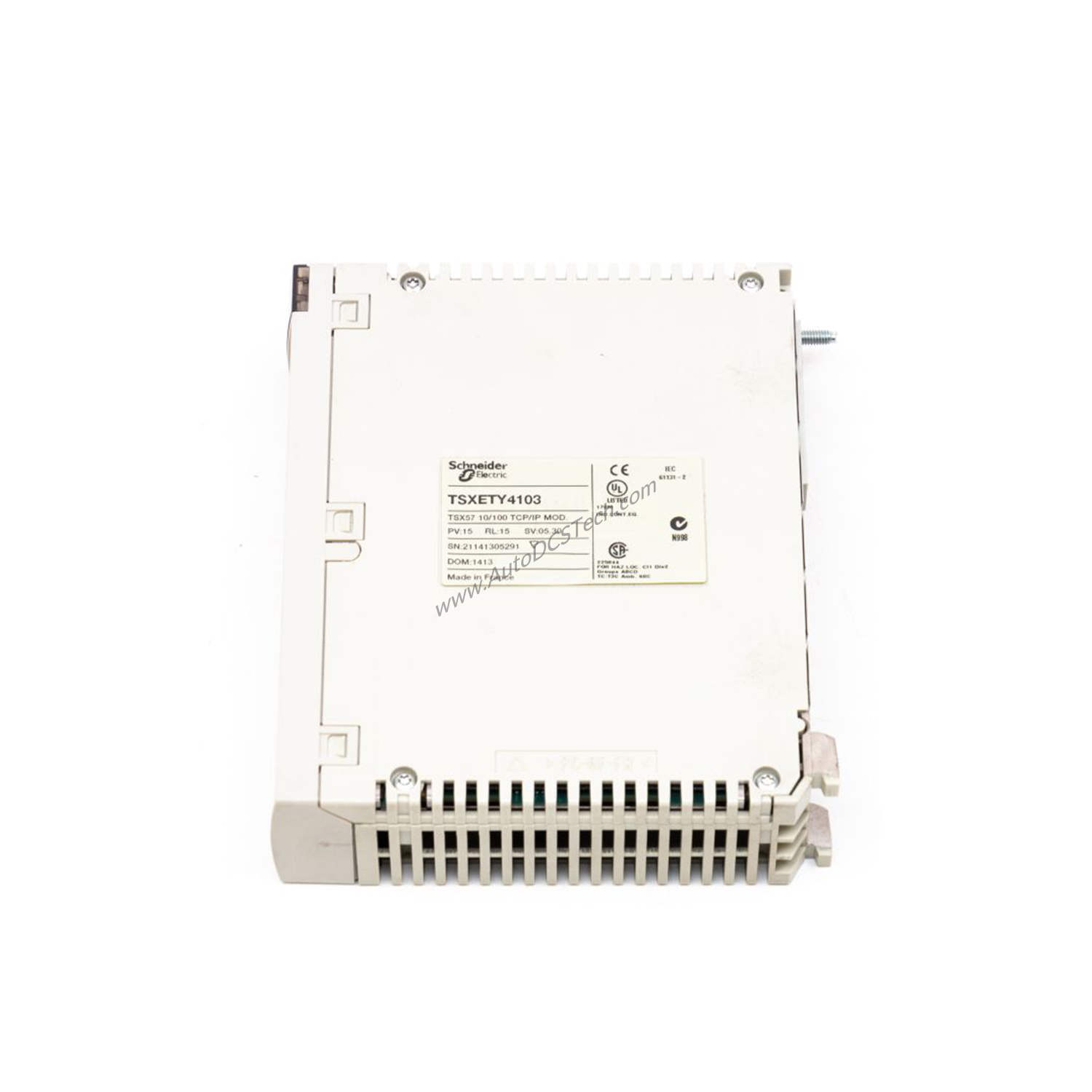
Product Overview
When industrial networks demand reliable bridging between Ethernet and serial Modbus devices, the Schneider TSXETG100 delivers a cost-effective solution. Part of the TSX Micro PLCs series, this Ethernet Modbus gateway/router operates on a rated supply voltage of 24 V DC, reducing power infrastructure costs compared to higher-voltage alternatives. Its support for multiple Ethernet protocols—Modbus TCP/IP, HTTP, FTP, SNMP, and ARP—enables flexible integration without expensive protocol converters, lowering total system expenditure.
Technical Specifications Breakdown
The TSXETG100 provides key specifications that directly impact operational efficiency and budget. The RJ45 10/100 Mbps Ethernet connection ensures compatibility with standard network infrastructure, avoiding costly proprietary cabling. Serial link options include RS485 at 57.6 kbps and RS232 at 38.4 kbps, allowing connection to legacy equipment without additional adapters—saving both hardware and labor costs. With a maximum of less than 32 devices on the Modbus serial link, this module supports moderate-sized networks efficiently, preventing overspending on oversized gateways. The compact dimensions (2.8 x 3.2 x 3.0 inches) and lightweight design (3.00 lbs / 1.36 kg) reduce mounting and shipping expenses. Compliance with standards such as UL 508 and FCC class A minimizes certification risks and potential rework costs.
Industry Applications
In manufacturing lines, the TSXETG100 connects older Modbus RTU sensors to modern Ethernet-based SCADA systems. This eliminates the need to replace functional but serial-only devices, offering a high return on investment by extending equipment life. For building automation, the module bridges Modbus ASCII energy meters to an HTTP-based monitoring dashboard, reducing energy waste through real-time diagnostics.
Installation & Setup Guidance
Mount the TSXETG100 on a symmetrical DIN rail for secure, space-efficient installation. Connect the 24 V DC supply to the power input, ensuring polarity matches. Use a standard RJ45 cable for Ethernet and the 5-way removable terminal block for RS485 serial links. Configure protocols via the BOOTP client or predefined web pages—no specialized software licenses required, keeping setup costs low. Verify LED indicators (3 for serial: RS485, RX, TX; 4 for Ethernet: LK, RX, TX, 100) to confirm link status.
Maintenance & Reliability
Routine maintenance is minimal, reducing long-term ownership costs. Operate the module within 32-140 °F (0-60 °C) and 5-95% relative humidity (non-condensing) to avoid environmental failures. The IP30 protection shields against dust and accidental contact, lowering the risk of downtime. Periodic inspection of the RJ45 and terminal block connections ensures signal integrity, preventing costly production stoppages.
Compatibility & Integration
Its support for Modbus TCP/IP and Modbus RTU/ASCII allows direct communication with existing networks, eliminating the need for expensive middleware. The built-in web server (Class B10) provides diagnostic access via standard browsers, reducing training and support costs.
What is the rated supply voltage for the TSXETG100?
The rated supply voltage is 24 V DC, as specified in the technical data.
How many devices can connect to the Modbus serial link?
The maximum number of connected devices is less than 32 on the Modbus serial link.
Does the TSXETG100 support PoE?
Yes, it can be powered via PoE IEEE 802.3af, offering flexible installation options.
What Ethernet protocols are supported?
Supported protocols include Modbus TCP/IP, HTTP, FTP, SNMP, and ARP.
Is the TSXETG100 certified for safety?
It holds cUL and UL certifications and complies with UL 508 and other standards.
Availability & Condition at AutoDCSTech
| Part Number | TSXETG100 |
|---|---|
| Availability | In Stock |
| Condition | New |
| Warranty | One Year |
| Origin | France |