At the 26th China International Industry Fair (CIIF 2026), held 12–16 October 2026 in Shanghai, KUKA China — the robotics arm of the Midea Group — unveiled its KUKA KAI intelligent platform and announced that its MIRO (美罗) humanoid robot is now ready for commercial sale. KAI (short for KUKA Advanced Intelligence) is positioned not as a single software tool but as a plant-wide "brain" that unifies equipment data, production scheduling and execution. Together with the MIRO humanoid, new collaborative robots and Midea's in-house robot components, the launch marks KUKA's shift from an automation equipment supplier to a full-plant intelligent-solution provider.
Key takeaways
- What launched: KUKA KAI (KUKA Advanced Intelligence), a hierarchical "production-line automation brain" built on a perception–decision–execution–evolution loop.
- Humanoid milestone: The MIRO (美罗) wheeled humanoid robot, after roughly a year of stability testing, is described by KUKA as ready for real-world deployment and sale.
- MIRO capability: Industrial-grade wheeled humanoid rated to carry about 20 kg with 6+ hours of runtime; demonstrated on popcorn serving, material handling, forklift collaboration and parcel sorting.
- Supporting lineup: KUKA LBR NEXUS collaborative robot (7–20 kg payload, CE/NRTL certified), Visual Components CN, an embodied-AI product family and a new automated welding solution.
- Component depth: Midea's Weiling brand released force-control integrated joint modules, frameless torque motors and multiple reducers in October, closing the core-components gap.
What the KUKA KAI intelligent platform actually does
Modern factories are rarely short of data. Sensors line every line, machines report their own status, and dashboards refresh in real time — yet the decisions still tend to run through human operators, and execution stays fragmented across systems. KUKA KAI is designed to close that gap. The platform ingests data from heterogeneous equipment into a single layer, analyses and schedules with AI, issues commands to the shop floor, and then feeds execution results back to refine the next decision — a loop the company summarises as "perception, decision, execution, evolution."
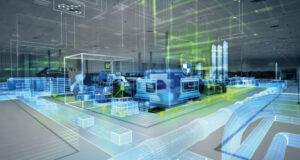
The defining technical element is digital-twin validation. Before an AI-generated decision reaches physical machines, it is rehearsed inside a virtual replica of the factory. Only decisions that pass in simulation are released to real equipment, which is KUKA's answer to a persistent objection against industrial AI: the risk that a confident but wrong model halts a line or damages tooling. In KUKA's framing, this is what lets the system "get smarter the more you use it" while keeping the failure mode contained.
MIRO (美罗): a humanoid robot KUKA says is ready to sell
The most closely watched exhibit was MIRO (美罗), an industrial-grade wheeled humanoid robot. On the stand it ran a full popcorn sequence — spotting a cup, gripping it, filling it, and offering it back while sensing a visitor's hand before releasing — a deliberately interactive demonstration meant to show stability rather than a scripted stunt.
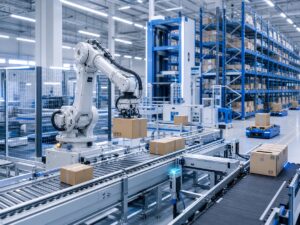
Behind the theatrics, the practical specification is what matters to buyers: MIRO is rated to carry roughly 20 kg and run for more than six hours, and it was shown performing material handling, coordinated work with forklifts, and parcel sorting. In the sorting scenario the robot goes beyond fixed vision-guided pick-and-place: when it sees a parcel whose shipping label is not facing up, it reorients the box so the label is readable — behaviour KUKA attributes to a large model doing scene understanding and real-time control.
According to remarks carried by Chinese business media (including Securities Daily), MIRO has completed about a year of stability polishing and testing and now meets the conditions for on-the-ground sale. That "ready to sell" status is the headline: it signals the product has crossed from demonstration to engineering-hardened deliverable.
The rest of the CIIF 2026 KUKA lineup
KAI is the software spine; the hardware around it is what executes the decisions. Alongside the platform, KUKA introduced:
- KUKA LBR NEXUS — a collaborative robot positioned as an execution terminal within the KAI architecture, blending German precision engineering with China-oriented design for high-mix, low-volume, frequent-changeover production. It covers 7–20 kg payloads and carries CE/NRTL certification.
- Visual Components CN — a locally adapted simulation and digital-twin toolchain that feeds the "validate before you deploy" model KAI relies on.
- An embodied-AI product family — the idea of one AI "brain" driving multiple robot bodies, so a single intelligence layer can be reused across forms.
- A new automated welding solution pitched as near plug-and-play on arrival, plus a voice-driven HMI copilot that lets operators task a cobot by speaking to it.
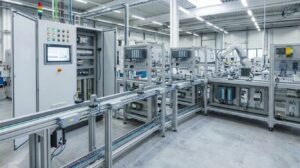
The wider KUKA stand ran more than a dozen live workstations spanning semiconductor, new-energy, logistics and sheet-metal scenarios — a deliberate move to show delivered, running production lines rather than isolated robots.
Weiling: Midea fills in the robot components
A platform and a humanoid are only as good as the motors, reducers and joints underneath. In the same month, Weiling — Midea's industrial-technology brand — released a force-control integrated joint module, a frameless torque motor and several reducers. Those parts govern how a robot turns, controls force and completes a motion, so the launch completes Midea's story from the "brain" (KAI) down to the "joints": a full industrial chain from core components through robots to whole-plant software.
Why this matters for automation buyers and maintenance teams
For teams that keep existing lines running, the strategic signal is that humanoid and embodied robots are moving toward purchasable, serviceable products — which eventually means demand for the same categories of parts that already circulate through a distributor: servo drives, VFD drives, encoders and PLC & I/O modules. Robotics and motion control overlap heavily with established industrial brands — see our Fanuc, ABB and Yaskawa catalogues, and the Siemens, Schneider Electric and Lenze ranges that supply the drives, motors and controls behind most automated cells.
The practical near-term read for plant managers: KAI-style platforms lower the barrier to validating AI decisions safely through simulation, while "ready-to-sell" humanoids such as MIRO are most credible first in structured logistics and material-handling tasks rather than as drop-in replacements for fixed automation. We track these shifts in our industry news desk and translate them into sourcing guidance in our buying guides.
Frequently asked questions
What is KUKA KAI?
KAI stands for KUKA Advanced Intelligence. It is a plant-level AI platform that aggregates equipment data, makes and schedules decisions, dispatches commands to machines, and learns from execution results — with digital-twin simulation used to validate decisions before they reach physical equipment.
Is the MIRO humanoid robot for sale?
KUKA said at CIIF 2026 that MIRO (美罗), after about a year of stability testing, meets the conditions for commercial sale. It is an industrial-grade wheeled humanoid rated for roughly 20 kg of payload and 6+ hours of runtime.
What can MIRO actually do?
Demonstrated tasks include popcorn serving, material handling, working in coordination with forklifts, and parcel sorting — including reorienting a package so its shipping label faces the scanner, driven by large-model scene understanding.
How does this fit Midea's robotics strategy?
KUKA provides the robots and the KAI platform, while Midea's Weiling brand supplies core components such as joint modules, frameless torque motors and reducers — covering the chain from "brain" to "joints."
Looking for 2026?
Browse genuine 2026 units, specifications, and pricing — or request a quote from our automation specialists.
View 2026 Products & Get a Quote →