Introduction
Industrial automation has evolved from simple relay logic to sophisticated, safety-critical control systems. Today, process plants demand controllers that not only manage complex operations but also ensure personnel and asset safety. The ABB PM857K02 MPC866 controller represents this evolution, offering a powerful platform for high-integrity applications. With its SIL 3 certification and redundant architecture, it addresses the growing need for reliable, fail-safe control in industries like oil and gas, chemicals, and power generation.
Technical Specifications Breakdown
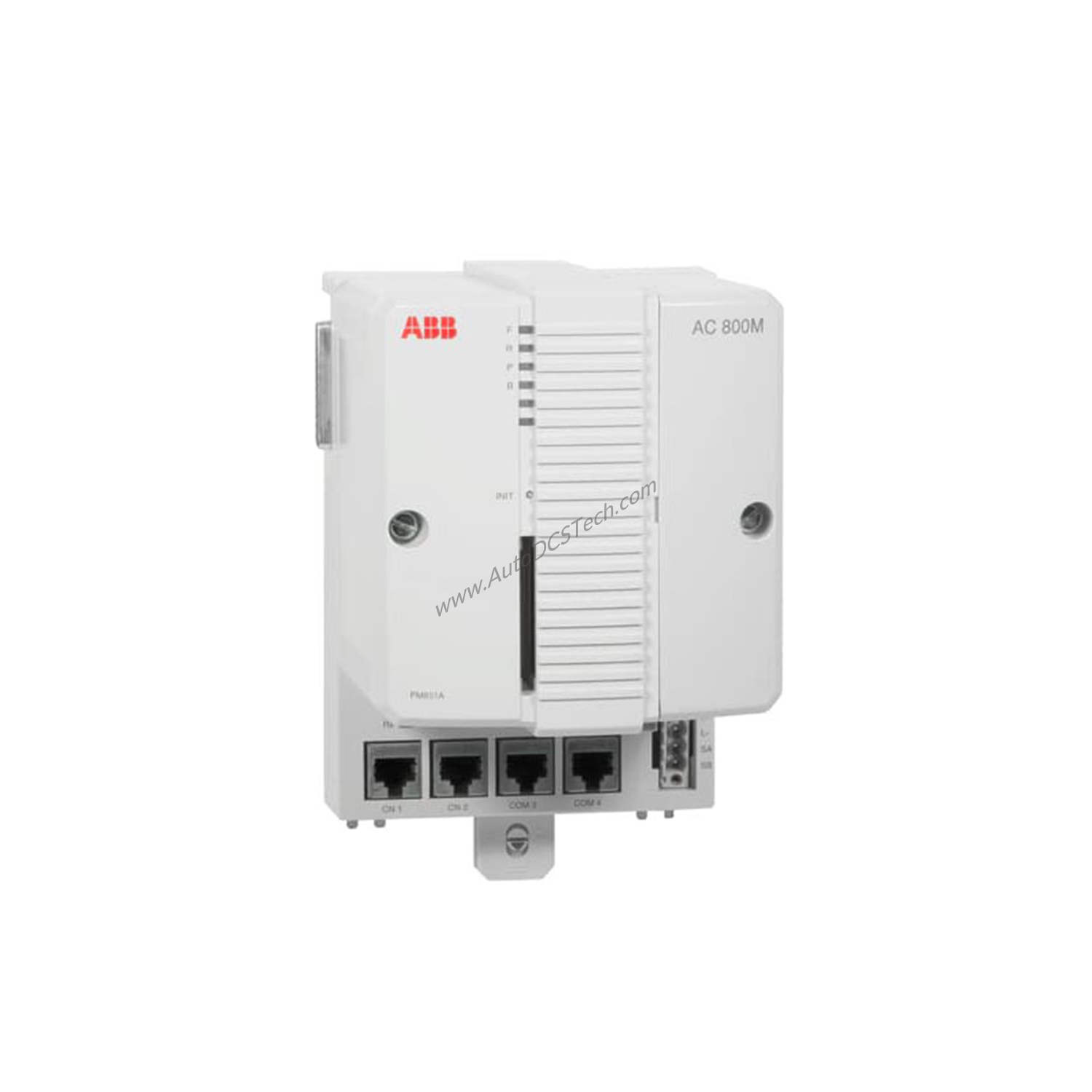
At the heart of the PM857K02 is the MPC866 processor running at 96 MHz, delivering a performance of 0.17 ms for 1000 boolean operations. This speed ensures rapid logic execution for time-critical processes. The controller features 32 MB of memory, with 22.184 MB available for applications, allowing complex control strategies to run . For firmware storage, it includes 18 MB of Flash PROM, while a built-in lithium backup battery (3.6 V) maintains the real-time clock and critical data during power loss.
Communication is a key strength. The controller provides two RJ45 Ethernet ports (10 Mbit/s, IEEE 802.3) for the Control Network, supporting MMS and IAC protocols. It also includes two RS-232C interfaces: COM3 (non-redundant only) operates at 75-19,200 baud with full RTS-CTS support, while COM4 (non-redundant only) is opto-isolated at 9,600 baud for configuration tools. The redundant configuration ensures a switch-over time of max 10 ms, maintaining uptime in critical operations.
Power supply requirements are 24 V DC (19.2-30 V DC), with typical consumption of 210 mA and maximum 360 mA. Power dissipation is 5.1 W typical (8.6 W max). The controller supports up to 12 communication modules on the CEX bus and can handle a maximum of 128 I/O signals in total, with up to 96 I/O modules on the Modulebus for a single CPU or 84 for redundant CPUs.
Industry Applications
Its SIL 3 certification, achieved with the SM812 module and certified software, allows it to manage safety-critical functions without compromising process control. For example, a refinery can use the controller to monitor pressure and temperature in a distillation column, triggering shutdowns if parameters exceed safe limits. The redundant CPU ensures that a single processor failure does not halt production.
In chemical manufacturing, the controller handles batch processes requiring precise sequencing and safety interlocks. With support for 32 applications per controller and 64 programs per application, it can manage multiple recipes simultaneously. The event queue (up to 3000 events per OPC client) provides detailed audit trails for compliance with regulations like IEC 61508.
Installation & Setup Guidance
Mount the PM857K02 in a clean, dry environment with an IP20-rated enclosure. Ensure the ambient temperature stays between +5 to +55 °C (+41 to +131 °F). Connect the 24 V DC power supply to the designated terminals, observing polarity. For redundant configurations, use the TK850 CEX-bus expansion cable and TK851 RCU-Link cable included in the package. Configure the Ethernet ports (CN1, CN2) for the Control Network using standard RJ-45 cables. Set the RS-232C ports according to your tool requirements: COM3 for general use with modem control, COM4 for isolated configuration. Always refer to the Safety Manual for SIL-related setup.
Maintenance & Reliability
Regular inspection of the PM857K02 ensures long-term reliability. Check the LED indicators for normal operation: they provide status on power, communication, and errors. Verify the backup battery (lithium, 3.6 V) every 12 months and replace if low. Keep the enclosure free from dust and moisture, as the controller is rated for pollution degree 2 and 5-95% non-condensing humidity. The controller's G3 corrosion protection (per ISA 71.04) makes it suitable for harsh industrial environments. For SIL applications, follow the manufacturer's safety manual for periodic testing of safety functions.
Compatibility & Integration
It supports S800 I/O modules, including High Integrity variants, and communicates over the Control Network using MMS and IAC protocols. The recommended backbone is 100 Mbit/s switched Ethernet. For high-integrity setups, add the SM812 module to enable SIL 2 and SIL 3 certified control. The controller also supports CPU redundancy, CEX-bus expansion, and up to 12 communication modules. It is certified for marine applications (ABS, BV, DNV-GL) and hazardous locations (cULus Class 1, Zone 2).
Selection Guide & Purchasing Advice
Before purchasing the ABB PM857K02, verify your system's requirements: ensure your I/O count does not exceed 128 signals, and confirm the need for SIL 3 certification. The package includes two PM857K01 safety processor units, one TK850 cable, and one TK851 cable. If you require redundancy, ensure your chassis and power supply support it. Contact AutoDCSTech for current availability and lifecycle status. As a trusted supplier of industrial automation parts, AutoDCSTech can help you select the right configuration and provide support for integration.
Availability & Condition at AutoDCSTech
| Part Number | PM857K02 |
|---|---|
| Availability | In Stock |
| Condition | New |
| Warranty | One Year |
| Origin | Switzerland |