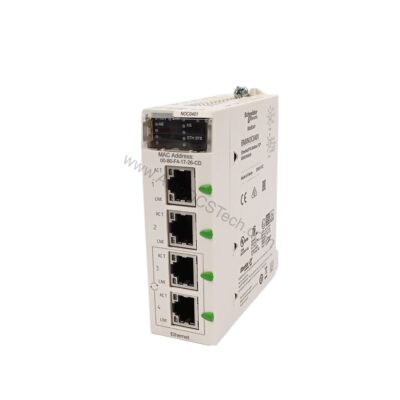
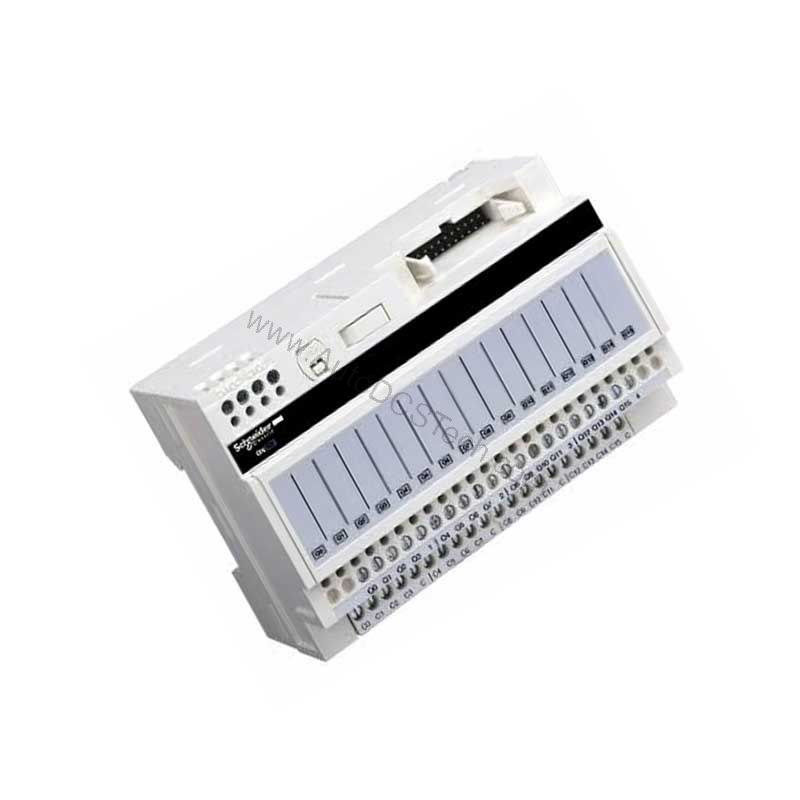
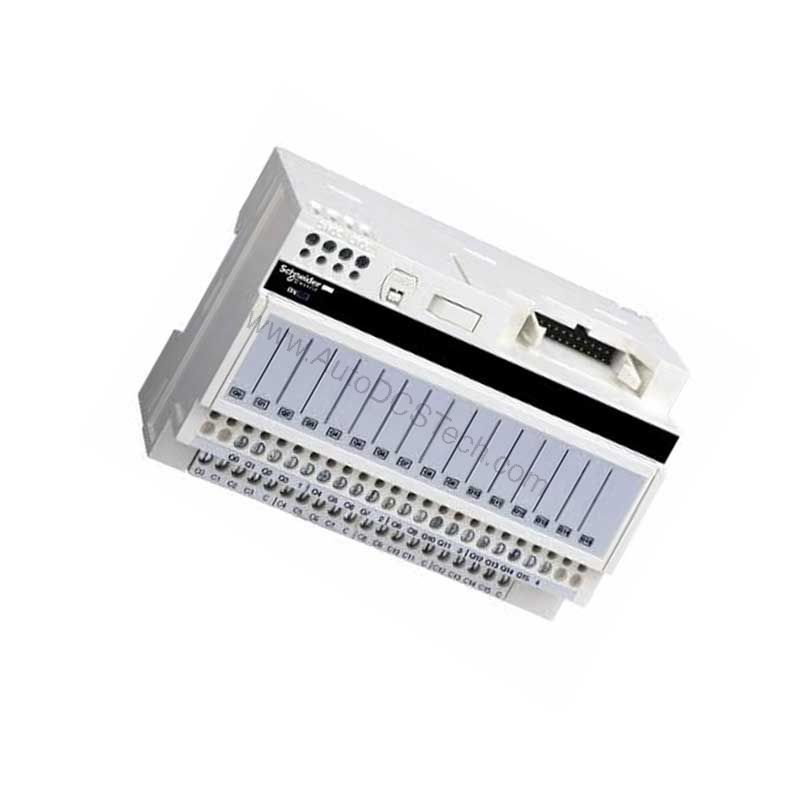
Schneider Electric ABE7E16EPN20 is a passive discrete I/O sub-base from the Modicon ABE7 range, designed to interface 16 discrete channels with Twido programmable controllers. It operates with a 24 V DC supply on both the controller side and the sensor/controller side, and it provides screw-type terminals for secure field wiring.
What are the key electrical and mechanical specifications of this unit?
The module's supply voltage limits are 19…30 V DC on the controller side and 20.4…26.4 V DC on the sensor/controller side, both according to IEC 61131-2. It accepts a maximum supply current of 2 A and includes a 2 A internal fuse (5 x 20 mm, fast blow) on the controller side for short-circuit protection. The rated insulation voltage is 2000 V between terminals and mounting rails, and the voltage drop on the power supply fuse is 0.3 V. The input circuit switched current is 15 mA.
Mechanically, the sub-base mounts on 35 mm symmetrical DIN rail (IEC 60715) using clips or screws. It features a HE-10 connector with 20 pins and screw terminals that accept a range of wire sizes, from 0.09 mm² to 2.5 mm² (AWG 28 to AWG 12), depending on the wire type and configuration. The tightening torque for the terminals is 0.6 N.m (5.3 lbf.in) using a flat Ø 3.5 mm screwdriver. The net weight is 0.43 kg (0.95 lb).
How does this unit ensure reliable operation in industrial environments?
The sub-base is designed to withstand demanding conditions. It has an IP2X degree of protection conforming to IEC 60529, which guards against solid objects larger than 12 mm. The operational ambient temperature range is -5…60 °C (23…140 °F) per IEC 61131-2, while storage temperature extends from -40…80 °C (-40…176 °F). Resistance to electrostatic discharge is 4 kV contact and 8 kV air (level 3, IEC 61000-4-2), and resistance to fast transients is 2 kV (level 3, IEC 61000-4-4). The product also meets shock resistance of 15 gn for 11 ms (IEC 60068-2-27) and vibration resistance of 2 gn at 10…150 Hz (IEC 60068-2-6).
These specifications make this unit suitable for industrial automation panels where space and reliability are critical. The module is compatible with Twido programmable controllers, specifically the TWDDDI16DK and TWDDDI32DK models, and it carries CSA and UL certifications.
What are the typical applications for this passive discrete I/O sub-base?
Because this unit provides 16 discrete input channels with a common polarity distribution (1 common per 16 channels), it is often used to consolidate field wiring in control cabinets. It connects sensors and actuators to Twido controllers via the HE-10 connector, reducing wiring complexity. The screw terminals accommodate both solid and flexible wires, with or without cable ends, which simplifies installation and maintenance.
Engineers select this sub-base when they need a compact, DIN-rail-mounted interface that handles 24 V DC signals and offers a high channel count. The integrated fuse protects the controller side from short circuits, while the 2000 V insulation rating helps ensure safety and signal integrity.
How to integrate this unit into a control system?
Mount the sub-base on a 35 mm DIN rail and secure it with clips or screws. Connect the 24 V DC supply to the appropriate terminals, observing the voltage limits for the controller side (19…30 V DC) and sensor/controller side (20.4…26.4 V DC). Use the HE-10 connector to link the sub-base to the Twido controller. For field wiring, strip wires to the specified lengths and tighten the screw terminals to 0.6 N.m. The status LED indicates power ON, which aids in commissioning.
When wiring into a network or remote I/O system, confirm that the Twido controller configuration matches the sub-base's channel count and input logic. Always follow local electrical codes and the manufacturer's installation instructions.
Availability & Condition at AutoDCSTech
| Part Number | ABE7E16EPN20 |
|---|