On 19 November 2026, Schneider Electric India and Boston Consulting Group announced an Exploration Agreement to demonstrate industrial AI, automation and connected production to Indian manufacturers. The demonstrations use Schneider's existing plants, including its Industry 4.0 Lighthouse Factory in Hyderabad, as a Model Smart Factory reference. No investment value, participant count or completion timetable has been disclosed, and participants keep full technology and supplier discretion.
- The agreement: an Exploration Agreement announced in New Delhi on 19 November 2026 and reported by Industrial News on 20 November 2026. It is a collaboration to demonstrate and evaluate technologies, not a programme of installations at customer factories.
- The host sites: Schneider Electric's existing production environments, including the Industry 4.0 Lighthouse Factory in Hyderabad.
- The approach: a Model Smart Factory reference where manufacturers observe digital technologies operating in a live plant and assess whether those applications suit their own operations.
- The technology scope: connected operations, industrial AI, machine connectivity, predictive maintenance, energy management and software-defined automation.
- The division of labour: Schneider Electric provides manufacturing infrastructure and operating experience; BCG contributes expertise in evaluating production processes and identifying opportunities for digital and operational change.
- The commercial limits: technology and vendor decisions stay with each participating organisation. The agreement does not require manufacturers to purchase Schneider Electric systems or appoint BCG for later projects.
- The evidence gap: no comparative data has been published on energy consumption, productivity, maintenance cost or production quality, and no participating manufacturers or deployment dates have been named.
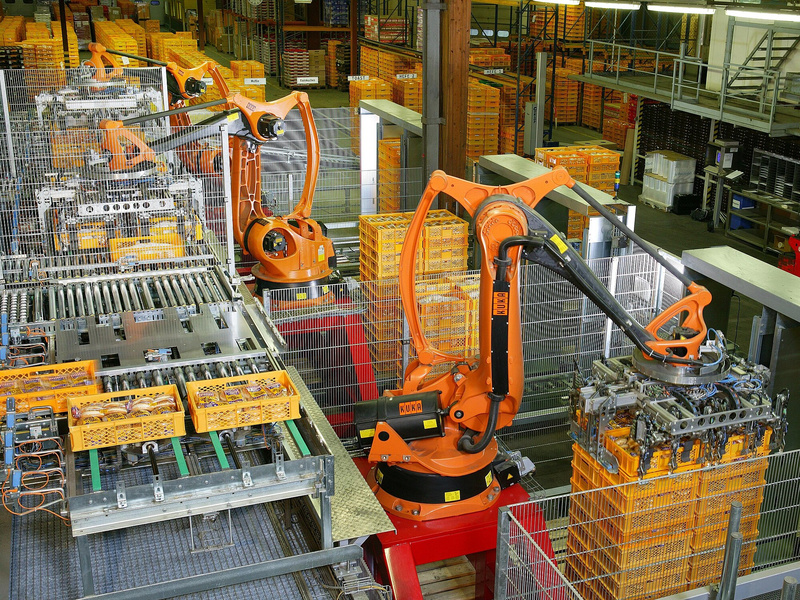
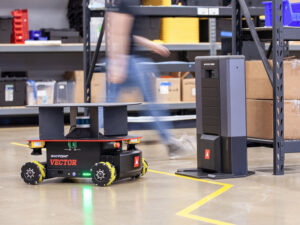
Illustrative image: an automated palletizing line, the kind of live production environment the Model Smart Factory approach is meant to open to visiting manufacturers.
What did Schneider Electric and BCG actually agree to?
They announced an Exploration Agreement, not a customer rollout. Schneider Electric brings manufacturing infrastructure and operating experience; BCG brings expertise in digital and operational transformation. The stated aim is to let manufacturers experience Industry 4.0 technologies in a live production environment, evaluate them, and decide whether to scale them in their own plants.
Exploration Agreement is the term used in the announcement itself, which ETManufacturing describes as a strategic collaboration. The wording matters. Nothing in the published material commits either company to a procurement volume, an exclusivity arrangement or a revenue target, and Industrial News states plainly that the arrangement is an Exploration Agreement rather than a confirmed programme of installations at customer factories.
For an industrial reader, the practical unit here is a reference visit plus an assessment conversation. A manufacturer can see applications running on real equipment and discuss its own production process with BCG, but the decision to buy hardware, software or consulting services remains separate and optional.
What is a Model Smart Factory under this agreement?
It is an approach, not a new building. The companies intend to develop a Model Smart Factory approach that lets manufacturers examine digital technologies running in a real production environment and assess their suitability for their own operations. Initial activities take place inside Schneider Electric's existing manufacturing facilities rather than a dedicated demonstration centre.
The distinction between an approach and a facility is not semantic. A dedicated demo centre can be arranged around ideal conditions. An operating plant carries the equipment mix, shift patterns, maintenance backlog and integration history that a visiting manufacturer will recognise from its own site. Industrial News describes the intent as helping companies evaluate automation, predictive maintenance and connected production rather than prescribing a single implementation model for every factory.
| Attribute | Detail |
|---|---|
| Agreement type | Exploration Agreement, described as a strategic collaboration |
| Announced | 19 November 2026, New Delhi; reported by Industrial News on 20 November 2026 |
| Parties | Schneider Electric India and Boston Consulting Group |
| Host environment | Schneider Electric's existing production facilities, including the Industry 4.0 Lighthouse Factory in Hyderabad |
| Approach | Model Smart Factory: observe, evaluate and assess technologies in a live plant |
| Technology scope | Connected operations, industrial AI, machine connectivity, predictive maintenance, energy management, software-defined automation |
| Roles | Schneider Electric: manufacturing infrastructure and operating experience. BCG: production process assessment and digital/operational change opportunities |
| Commercial terms | No purchase obligation and no requirement to appoint BCG for later projects; technology and vendor decisions remain with each organisation |
Which six technology areas will be demonstrated?
The demonstration scope covers connected operations, industrial artificial intelligence, machine connectivity, predictive maintenance, energy management and software-defined automation. Those six areas describe the category of technology on show, not a validated result at any site. Each area depends on data quality, equipment compatibility and engineering work that varies by plant.
The list is broad enough that two manufacturers can visit the same plant and come away with different priorities. A line with mixed-vintage controllers will care most about connectivity and integration effort. A plant with high energy intensity will care about metering coverage and load context. A site with critical rotating equipment will care about how condition data is collected and how false alerts are handled.
| Demonstration area | What it involves | What it does not establish |
|---|---|---|
| Connected operations | Bringing production data from machines and lines into a shared operational view, including equipment from different vendors and commissioning dates | That the same integration pattern will fit a different equipment mix without new engineering work |
| Industrial AI | Applying models to production data for analysis and decision support | That a model validated on one line will hold its accuracy on another process or product |
| Machine connectivity | Transferring operating data such as machine status, process measurements, production counts, energy use and maintenance conditions into monitoring or analysis systems | That every controller, drive and sensor on a visitor's site can expose the required data without gateways or retrofit work |
| Predictive maintenance | Analysing condition changes associated with developing faults so maintenance teams can investigate before a failure stops production | That alert thresholds and failure models will transfer to different equipment, duty cycles and maintenance regimes |
| Energy management | Monitoring electricity use across machinery, utilities and production areas and linking consumption to operating conditions | That consumption reductions seen in one plant are available in another with different processes and scheduling constraints |
| Software-defined automation | Software architectures that reduce dependence between automation applications and specific hardware platforms | That control functions can move between platforms without real-time validation, compatibility testing and commissioning |
Connectivity is the common dependency behind most of the list. Production lines usually contain controllers, drives, sensors and management software supplied by several companies and commissioned at different times, and those systems may use different communication arrangements. Existing PLC and I/O modules are often the first place where that integration work becomes visible, because the controller determines which data can be exposed and in what format.
The same applies to the drive layer. Industrial drives and motors increasingly publish operating and energy data, but the available parameters depend on the model and firmware. A demonstration on newer equipment does not automatically describe what is possible on an installed base commissioned a decade earlier.
What is confirmed, and what is not?
Confirmed: the agreement's existence and date, the host sites, the six technology areas, the division of roles, and the participants' freedom to choose vendors. Not disclosed: investment value, number of participating manufacturers, deployment timetable, named applications, measured outcomes, and any installations at customer factories.
The gap between confirmed and undisclosed is where most misreading happens. A demonstration agreement is a statement of intent and access, not a performance claim. The table below separates what the announcement and the reporting establish from what has simply not been published as of 23 November 2026.
| Item | Status |
|---|---|
| Exploration Agreement between Schneider Electric India and BCG | Confirmed in the 19 November 2026 announcement |
| Use of existing Schneider plants, including Hyderabad | Confirmed |
| Six technology demonstration areas | Confirmed |
| Division of roles between the two companies | Confirmed |
| Participants retain technology and vendor decisions | Confirmed in the release and in Industrial News reporting |
| Investment value | Not disclosed |
| Number of participating manufacturers | Not disclosed |
| Timetable for completed deployments | Not disclosed |
| Named applications or production lines in scope | Not disclosed |
| Measured energy, productivity, maintenance or quality gains | No comparative data published |
| Installations at customer factories | None announced; explicitly not a confirmed installation programme |
| Separate BCG-hosted announcement | Not found as of 23 November 2026 |
Not disclosed does not mean the opposite is true. It means a reader cannot conclude either way. That applies with particular force to outcome claims: the partners have not published comparative data showing improvements in energy consumption, productivity, maintenance costs or production quality, and Industrial News notes that individual projects would require suitable measurement before such outcomes could be established.
Why does the Hyderabad lighthouse matter as a reference site?
The Hyderabad plant is a World Economic Forum Global Lighthouse Network site. Schneider Electric has announced its recognition as an Advanced Lighthouse and later as a Sustainability Lighthouse. Using an operating plant instead of a simulation lab lets visitors see integration constraints, legacy equipment and live production conditions, though it does not guarantee that a demonstrated application will transfer unchanged to another factory.
The Global Lighthouse Network is the World Economic Forum's programme for manufacturing sites that apply Fourth Industrial Revolution technologies at scale. A site in that network has already been assessed on deployed technology rather than a pilot slide. For a visiting manufacturer, the value is the ability to ask how a specific application was integrated, what data it depends on and what changed in daily operations, in a plant that is actually producing.
The limit is transferability. A technology that works in one production facility may need different interfaces, sensors or control arrangements elsewhere. Machine age, existing automation, process characteristics and site operating procedures all influence the engineering work required, which is why the assessment conversation with BCG sits alongside the demonstration rather than after it.
What did the two companies say about measurable outcomes?
Deepak Sharma framed the agreement around manufacturers wanting proven pathways to implement digitalisation, automation and AI at scale. Sharad Verma framed it around moving from strategic intent to hands-on evaluation in a live manufacturing setting. Neither statement includes a target, a metric, a baseline or a completion date.
Deepak Sharma, Zone President for Greater India and Managing Director and Chief Executive of Schneider Electric India, said: “While the intent to transform is strong, many organizations are looking for proven pathways to implement these technologies at scale. Through this collaboration with BCG, we are creating opportunities for manufacturers to experience advanced industrial technologies operating in a live production environment.”
Sharad Verma, Managing Director and Senior Partner at BCG, said: “Manufacturers today are looking beyond technology adoption to measurable business outcomes. This collaboration creates an environment where organizations can move from strategic intent to hands-on evaluation by seeing solutions demonstrated in a live manufacturing setting.”
Both statements describe the purpose of the arrangement. Neither converts it into evidence. A manufacturer that wants measurable outcomes still has to define the measurement, agree a baseline and run the evaluation on its own equipment.
Does the agreement require manufacturers to buy Schneider systems or hire BCG?
No. The release states that technology and vendor decisions remain at each organisation's discretion, and Industrial News reports that participating manufacturers are not required to purchase Schneider Electric systems or appoint BCG to implement subsequent projects. The agreement creates an evaluation setting, not a procurement commitment.
That freedom is the part most likely to be lost in summaries. A demonstration hosted by a vendor and a consultancy can still be a genuinely open evaluation, provided the visitor keeps control of the specification and the commercial decision. The published terms support that reading; the practical test is whether the assessment output is written in a form the manufacturer can take to alternative suppliers.
How should plant engineers and buyers read this announcement?
Treat it as a structured reference visit, not as evidence of performance. Useful questions are which applications are shown on which lines, what data architecture they depend on, what is measured and over what period, how much integration work a comparable plant would need, and how safety and OT security are handled.
Those questions turn a demonstration into a decision input. The checklist below is written for an engineering team preparing to visit a reference site or to compare this programme with its own modernisation plan.
- Scope: which production lines and equipment generations are included, and whether they resemble the visitor's installed base.
- Data path: which controllers, drives, sensors and gateways supply the data, and what happens to equipment that cannot expose it natively. The PLC and I/O range and operator panels and HMIs are useful reference points for what a retrofit typically touches.
- Measurement: what is recorded, against which baseline, over what period, and who validates the result.
- Integration effort: estimated engineering hours for a plant with the visitor's equipment mix, not the host plant's.
- Safety and security: how control functions are tested before changes reach production, and how OT network segregation is maintained.
- Commercial independence: whether the assessment report can be used with other suppliers and integrators.
Existing catalogue items give a sense of the hardware layer behind these discussions. A Schneider ATV930 variable speed drive and an XBTGT1130 touch-screen HMI are the kind of components that sit between the process and the analytics layer, and their data capability depends on configuration rather than on the demonstration itself. The wider automation product catalogue shows how many equipment variants a single plant can contain.
Two adjacent developments are worth reading alongside this announcement. The shift toward software-defined switchgear and automation explains why hardware independence is being discussed at the control layer, while Schneider's own COP31 study on electricity cost ranges shows how energy figures should be read before they are treated as savings.
Frequently asked questions about the Schneider and BCG Model Smart Factory
Is this a confirmed factory deployment?
No. The arrangement is an Exploration Agreement to demonstrate and evaluate technologies in Schneider Electric's existing plants. Industrial News states that it is not a confirmed programme of installations at customer factories, and no customer site has been named.
When was the agreement announced?
The announcement was made in New Delhi on 19 November 2026. Industrial News reported the collaboration on 20 November 2026, and trade media published the release text on 21 November 2026. The agreement is exploratory rather than a signed supply contract.
Which Schneider Electric site hosts the demonstrations?
Initial activities use Schneider Electric's existing production environments, including its Industry 4.0 Lighthouse Factory in Hyderabad. The Hyderabad plant is part of the World Economic Forum's Global Lighthouse Network and has been recognised as an Advanced Lighthouse and as a Sustainability Lighthouse.
Which technologies are covered by the demonstration programme?
Six areas are named: connected operations, industrial artificial intelligence, machine connectivity, predictive maintenance, energy management and software-defined automation. The announcement does not specify which applications run on which production line.
Did the companies disclose investment, participants or a timetable?
No. No investment value, number of participating manufacturers or timetable for completed deployments has been published. No comparative data on energy, productivity, maintenance cost or quality outcomes has been released either.
Do participating manufacturers have to buy Schneider systems or hire BCG?
No. The release says technology and vendor decisions remain at each organisation's discretion, and Industrial News reports that the agreement does not require manufacturers to purchase Schneider Electric systems or appoint BCG to implement later projects.
Sources
- Industrial News: Schneider Electric and BCG plan smart factory demonstrations, 20 November 2026
- ETManufacturing: Schneider Electric, BCG join hands to accelerate AI-led smart manufacturing in India
- Industrial Automation: Schneider Electric and BCG collaborate, release text dated New Delhi, 19 November 2026
- Schneider Electric: World Economic Forum recognises Hyderabad factory as a Sustainability Lighthouse
- Schneider Electric: New recognition from the World Economic Forum (Advanced Lighthouse)
- World Economic Forum: Global Lighthouse Network