What Causes Premature Servo Inverter Failures in High-Load Applications?
The answer often lies in insufficient current headroom, inadequate thermal management, or imprecise encoder feedback. The Lenze EVS9330-ET, part of the Global Drive 9300 Servo Inverters series, addresses these failure modes through verified engineering-grade specifications: 89.0 A nominal output at 8 kHz switching frequency, 150% overload capability, and multi-encoder feedback supporting TTL/SinCos incremental and Hiperface absolute encoders. This article examines the EVS9330-ET through a failure mode analysis lens, detailing how its electrical and thermal characteristics mitigate common failure mechanisms in industrial servo applications.
Key Features and Verified Technical Specifications
- Rated motor power: 45.0 kW (4-pole asynchronous motor, 400 V).
- Rated output current: 89.0 A nominal at 8 kHz switching frequency.
- Maximum output current: 133.5 A at 8 kHz switching frequency (150% x In in overload mode).
- Supply voltage: 3/PE AC 320...528 V nominal, 45...65 Hz; alternative DC supply DC 460...740 V.
- Control: field-oriented servo control (SC) for synchronous and asynchronous servo motors and standard asynchronous motors.
- Program memory: 655 kByte flash per official catalogue (Servo PLC variants).
- Analog inputs: 2, +/-10 V (switchable 0...20 mA), 11 bits + sign.
- Analog outputs: 2, 9 bits + sign.
- Digital inputs: 6 (1 controller enable + 5 freely assignable), PLC level per IEC 61131-2.
- Digital outputs: 4, 50 mA per output.
The 150% overload capability at 8 kHz switching frequency provides critical headroom during acceleration and shock loads, directly reducing the risk of overcurrent trips and thermal stress on power semiconductors. The multi-encoder input accommodates TTL/SinCos incremental encoders and Hiperface absolute encoders, ensuring precise position feedback essential for failure-free operation in closed-loop systems.
Failure Mode Analysis: How the EVS9330-ET Mitigates Common Risks
Servo inverter failures typically stem from four root causes: overcurrent events, thermal overload, encoder signal loss, and environmental contamination. The EVS9330-ET addresses each through specific design features.
Overcurrent and Overload: The 133.5 A maximum output current at 8 kHz switching frequency provides 150% of nominal current for periodic overload cycles. This headroom is verified per the official 9300 Servo Inverters catalogue "Basic dimensioning of axis modules" (p.18), ensuring the drive can handle transient load spikes without nuisance tripping. For applications with high inertia loads or frequent acceleration cycles, this margin is critical to preventing IGBT failure from repeated overcurrent stress.
Thermal Management: Power loss at 400 V is 1100 W per the official rated-data table. The operating temperature range of 0...+50 °C ambient (sizes 9327-9332, 15-75 kW) includes output-current derating of 2.5%/°C above +40 °C. This derating curve is essential for applications in poorly ventilated enclosures or high-ambient environments—ignoring it is a leading cause of premature capacitor degradation and thermal shutdown. The IP20 protection rating requires installation in a controlled cabinet environment, where filtered air and proper clearance prevent conductive dust from bridging creepage distances.
Encoder Signal Integrity: The resolver input (Sub-D 9-pin) and multi-encoder input for TTL/SinCos incremental encoders and Hiperface absolute encoders provide redundant feedback options. In failure mode terms, this allows system designers to specify the encoder technology best suited to the environment: resolvers for high-vibration applications, Hiperface for absolute positioning without homing, and TTL/SinCos for high-resolution speed control. Signal loss due to cable damage or EMI is mitigated by the differential signal handling inherent to these interfaces.
Environmental Contamination: Relative humidity average 85% RH, without condensation (climatic class 3K3 per EN 50178), defines the operating envelope. In facilities where humidity spikes occur, cabinet heaters or dehumidifiers may be required to prevent condensation on cold surfaces—a common cause of insulation failure in servo drives.
Integration and Communication
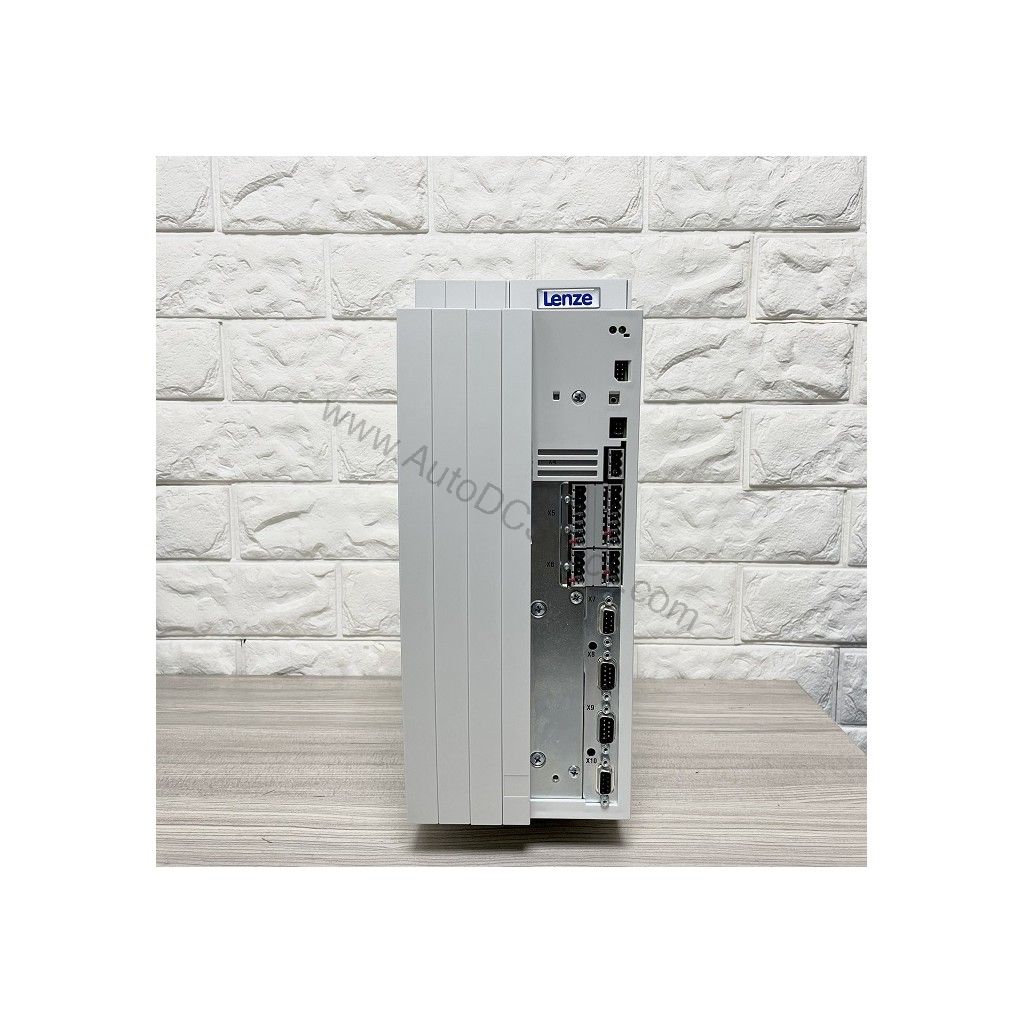
The EVS9330-ET integrates into automation architectures via the built-in CAN system bus (X4) with integrated CANopen protocol. The AIF automation interface (X1) accepts a keypad or attachable communication module, with expansion options for PROFIBUS DP (EMF2133IB), DeviceNet (EMF2179IB), INTERBUS (EMF2113IB), and LECOM A/B (EMF2102IB). For precise matching of communication modules to your network, contact AutoDCSTech with your exact requirements.
Integration Note: Wiring into fieldbus networks such as PROFIBUS DP or DeviceNet may require an external gateway or connection module. Confirm cable specifications and gateway compatibility with the supplier before commissioning.
Applications and Use Cases
The EVS9330-ET is engineered for applications demanding high torque density and precise speed regulation. In material handling, the 150% overload capability supports conveyor starts under full load without oversizing the drive. In packaging machinery, the field-oriented servo control (SC) enables synchronous operation of multiple axes via CANopen, with the 655 kByte flash program memory accommodating complex motion profiles. For textile production, the multi-encoder input supports both Hiperface absolute encoders for position-critical winding and TTL incremental encoders for high-speed spinning. In metal forming, the 45.0 kW rating and 89.0 A nominal current deliver the torque required for press feed rolls, while the resolver input ensures reliable feedback in high-vibration environments.
Maintenance and Reliability Planning
Planned maintenance extends service life and reduces unplanned downtime costs. Inspect cooling fans and heatsink fins every 2,000 operating hours or annually—clogged fins accelerate thermal derating and reduce output current capacity. Verify encoder cable shielding and connector torque at Sub-D 9-pin interfaces every 6 months; loose connections are a leading cause of intermittent feedback faults. In ambient temperatures above +40 °C, confirm the 2.5%/°C output-current derating is applied to prevent sustained thermal overload. Store spare units within -25...+55 °C per the official product information leaflet to preserve capacitor forming.
Product Support and Availability
The EVS9330-ET is in stock and ready to ship from AutoDCSTech. For engineering-grade precision in specifying replacement or upgrade paths, contact AutoDCSTech with your exact requirements for precise matching. Our specialist engineering support can verify compatibility with your existing Global Drive 9300 installation and advise on migration options to the i950 platform where applicable.
Availability & Condition at AutoDCSTech
| Part Number | EVS9330-ET |
|---|