Technical Specifications Breakdown
The TSXCTY2C operates with an input voltage of 24 V, drawing 18 mA for sensors, 7 mA for auxiliary inputs, and 18 mA for encoders. Voltage limits are strictly defined: encoder input must be ≤ 5.5 V, while sensors and auxiliary inputs function within 19–30 V. For reliable logic detection, state 1 requires ≥ 11 V for sensors and auxiliary inputs, and ≥ 2.4 V for encoders. Conversely, state 0 is guaranteed at ≤ 1.2 V for encoders and ≤ 5 V for sensors and auxiliary inputs. Current thresholds are equally precise: state 1 demands ≥ 6 mA for sensors and auxiliary inputs, and ≥ 3.6 mA for encoders; state 0 requires ≤ 2 mA for sensors and auxiliary inputs, and ≤ 1 mA for encoders.
The module features 2 channels and supports a counting frequency of 1 MHz, with a cycle time of 1 ms. Power dissipation ranges from 7 to 10 W. The auxiliary output conforms to EN/IEC 61131 standards, ensuring compatibility with industrial control systems.
Industry Applications
In high-speed counting applications, the TSXCTY2C with its 1 MHz counting frequency and 1 ms cycle time. For example, in packaging lines where incremental encoders track product flow, the module's fast response time (< 2.5 ms at loss of 24 V auxiliary input) ensures minimal data loss during power interruptions. Similarly, in material handling systems using 2/3-wire proximity sensors, the module's positive logic input and wide voltage range (19–30 V) provide robust signal detection.
Installation & Setup Guidance
Mount the TSXCTY2C in a standard TSX Micro PLC rack. Connect sensors or encoders using the provided 1 connector HE-10 (20 pins) and 2 connectors SUB-D 15. Ensure input voltage stays within 19–30 V for sensors and auxiliary inputs, and ≤ 5.5 V for encoders. Verify wiring polarity: the module includes reverse polarity protection via a reverse diode on the supply. After installation, check the green RUN LED for module operation and the red I/O LED for external faults.
Maintenance & Reliability
Regularly inspect the module's environmental conditions. The TSXCTY2C operates in ambient temperatures from 32 to 140 °F (0 to 60 °C) and can be stored between -13 and 158 °F (-25 to 70 °C). Maintain relative humidity between 5 and 95% without condensation. Operating altitude should not exceed 6561.68 ft (2000 m). The module's thermal overload protection and short-circuit protection (via program or automatic thermal tripping) enhance reliability in demanding environments.
What Is the TSXCTY2C?
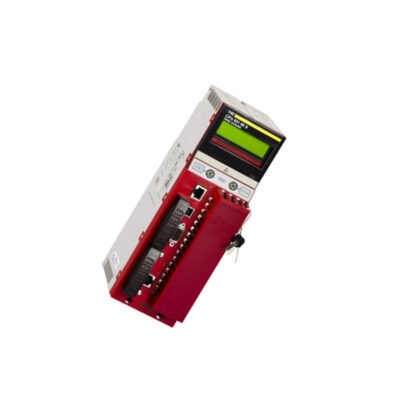
Part of the TSX Micro PLCs series, this module provides current sink auxiliary input functions including preset, enable, and read operations.
Compatibility & Integration
The TSXCTY2C integrates with TSX Micro PLCs and supports absolute encoders with parallel output (ABE7CPA11), incremental encoders (10–30 V totem pole or 5 V DC RS422), and SSI serial output encoders. The auxiliary output is compatible with positive logic DC inputs (resistance ≤ 15 kOhm). For sensor power, the module provides 24 V DC output with nominal current of 0.5 A.
Buying Guide & Purchasing Advice
Before purchasing the TSXCTY2C, verify your PLC system compatibility with TSX Micro series. Confirm input voltage requirements match your sensors and encoders. The module weighs 1.00 lbs (0.45 kg) and ships in a package measuring 10.2 x 7.09 x 2.2 inches. AutoDCSTech stocks this module and can assist with availability and replacement options if needed.
Frequently Asked Questions
Q1: What is the maximum counting frequency of the TSXCTY2C?
A1: The module supports a counting frequency of 1 MHz, with incremental encoder frequencies of 500 kHz (x1) and 250 kHz (x4).
Q2: Can the TSXCTY2C work with both PNP and NPN sensors?
A2: Yes, it is compatible with resistive 2/3-wire proximity sensors of both PNP and NPN types, conforming to IEC 1131 Type 2.
Q3: What is the response time when the 24 V auxiliary input is lost?
A3: The response time is less than 2.5 ms for sensor voltage at loss of 24 V auxiliary input.
Q4: Does the module provide output overload protection?
A4: Yes, it includes thermal tripping via program or automatically, along with current limiter and short-circuit protection.
Q5: What is the operating temperature range for the TSXCTY2C?
A5: The module operates in ambient temperatures from 32 to 140 °F (0 to 60 °C).
Availability & Condition at AutoDCSTech
| Part Number | TSXCTY2C |
|---|---|
| Availability | In Stock |
| Condition | New |
| Warranty | One Year |
| Origin | France |