Schneider Electric hosts a live webinar on 12 November 2026 at 10:00 CET with Nexans, Tridonic and VINCI Energies on hybrid AC/DC building distribution. The 700 VDC reference point is Nexans' AmpaCity pilot in Lyon, an office and R&D building rather than a factory. No measured end-to-end efficiency result has been published.
- The event: Next Generation Buildings: Accelerating Electrification Through Partnership, a live webinar on 12 November 2026 at 10:00 CET, with four speakers and a companion whitepaper.
- The partners: Schneider Electric covers distribution, protection, conversion and energy management; Nexans covers DC cabling; Tridonic covers DC lighting; VINCI Energies covers microgrid design and deployment.
- The deployment: AmpaCity in Lyon, first phase commissioned in May 2026, with a 700 VDC main bus feeding USB-C workstations, lighting, a 14.4 kWh battery and two 30 kW EV chargers through a Schneider-built interlink converter.
- The numbers: Nexans states that DC carries 20% to 60% more power through the same copper cross-section at 700 V and 350 V DC, and that studies with Schneider indicate copper savings of around 30%.
- The gap: none of those figures comes with a baseline, test conditions or a measurement period, and the webinar abstract does not publish results.
- The voltage: 700 VDC is the pilot's bus value, not an IEC nominal voltage class. It is not the same as 380 VDC data-centre rails or 750 VDC charger outputs.

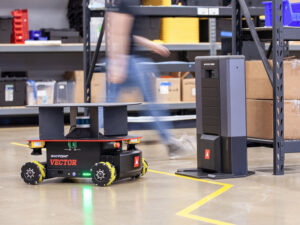
Illustrative image: a robot cell with drive cabinets and power cabling, the load side that hybrid AC/DC architectures aim to simplify.
What is the 12 November hybrid AC/DC webinar?
The session is a live webinar titled Next Generation Buildings: Accelerating Electrification Through Partnership, scheduled for 12 November 2026 at 10:00 CET. Schneider Electric hosts it with Nexans, Tridonic and VINCI Energies. It is not a trade fair, a product launch or a multi-part lecture series; registrants also receive a companion whitepaper on partnership in electrified buildings.
The format matters for how the content should be read. A live webinar with a whitepaper is a marketing and technical briefing, not a peer-reviewed test report. Speakers can present pilot experience, but nothing in the published agenda commits them to publishing measurement data.
| Attribute | Detail |
|---|---|
| Format | Live webinar, registration required |
| Title | Next Generation Buildings: Accelerating Electrification Through Partnership |
| Date and time | 12 November 2026, 10:00 CET |
| Host | Schneider Electric |
| Participating companies | Schneider Electric, Nexans, Tridonic, VINCI Energies |
| Speakers | Mili Anand (Schneider Electric), Nidhal Ben Mbarek (Nexans), Norbert Linder (Tridonic), Romain Scolan (VINCI Energies) |
| Moderator | Elan Meng, Senior Product Manager, Schneider Electric |
| Scope | Hybrid AC/DC buildings, loss and material reduction, partnership model |
Who is presenting, and what does each partner actually do?
Schneider Electric supplies the distribution, protection, conversion and energy-management layer; Nexans supplies the DC cabling and material science; Tridonic supplies DC lighting; VINCI Energies supplies microgrid design and deployment. That division of labour is stated by Nexans' innovation director, Jerome Fournier, and matches the four speakers listed for the session.
This is a four-company value chain, not four vendors selling the same box. Each partner owns a different failure mode of a DC building: the cable, the converter, the luminaire driver and the installation design. That is also why the session is framed around partnership rather than a single product.
| Partner | Role in the hybrid AC/DC architecture | Speaker |
|---|---|---|
| Schneider Electric | Distribution, protection, conversion and energy management; built the interlink converter used in the pilot | Mili Anand, Senior Engineer |
| Nexans | DC bus cable, insulation and ageing validation, interoperability testing | Nidhal Ben Mbarek, Direct Current Electrical Engineer |
| Tridonic | DC lighting and LED drivers, the historical entry point for DC in buildings | Norbert Linder, Director of Global Technology & Innovation |
| VINCI Energies | Microgrid engineering, installation design and deployment | Romain Scolan, Senior Project Lead |
For buyers, the practical question is which of these layers is commercially available. Nexans describes its DC Series cable range as available and Current/OS compliant. Schneider describes an interlink converter integrated for the pilot. Neither company has published a catalogue list of 700 VDC building SKUs, so any project should confirm availability per line item rather than assume a complete off-the-shelf system. Existing Schneider Electric automation parts and modules remain AC-fed unless a DC-rated variant is explicitly specified.
Is this a building pilot or a factory deployment?
The 700 VDC bus runs at Nexans' AmpaCity centre in Lyon, which the sources describe as an office and R&D building. No source describes a production hall or a manufacturing plant. Factory DC grids are a separate line of work: Germany's DC-INDUSTRIE2 project targeted production halls from 2019 to 2023 and handed results to the Open DC Alliance.
This distinction is not semantic. A production hall has motor loads, high fault levels, long cable runs and machine-level safety circuits. An office building has lighting, workstations, batteries and EV charging. The AmpaCity pilot validates the second list. Applying its voltage choice to a factory without a separate fault-level and protection study would be an assumption, not a result.
Industrial sites do have their own DC evidence base. DC-INDUSTRIE2 was a EUR 13 million German research project with 39 partners, focused on DC networks for production halls and on the power electronics needed to supply and protect them. Its open points were carried into the Open DC Alliance, initiated by ZVEI. That work is adjacent to the webinar, not part of it. Drives on an AGV or AMR fleet, for example, are already offered as a 24/48 V DC drive pair for AGV and AMR fleets, which is a different voltage layer from a 700 VDC building bus.
What exactly does 700 VDC mean here?
700 VDC is the AmpaCity pilot's main DC bus voltage, chosen for that installation rather than assigned by an IEC nominal-voltage table. Schneider Electric's own article calls it a 700/800 V DC bus, and Nexans presents 800 VDC as the next step for data centres. Treat 700 VDC as a design value, not a standard voltage class.
Voltage labels are the most common source of confusion in DC building coverage, because the same architecture is described with different numbers by different parties. The table below separates the values that are frequently mixed together.
| Value | Where it appears | What it is not |
|---|---|---|
| 700 VDC | AmpaCity main distribution bus in Lyon; described by Schneider as a 700/800 V DC bus | Not an IEC nominal voltage class and not a factory standard |
| 800 VDC | Nexans' stated next step for AI data centres with rack densities above 100 kW | Not the voltage of the commissioned AmpaCity phase |
| 750 VDC | Common in EV fast charging and traction systems | Not the bus value named for AmpaCity |
| 380 VDC | Data-centre and telecom DC distribution architectures | Not interchangeable with a 700 VDC bus or its protection gear |
| 48 VDC and 24 VDC | Rack power, sensors, drives and control electronics | Not a distribution voltage for building-scale loads |
Schneider's own wording, "700/800 V DC", is a useful warning: even the host company does not present a single fixed number. Any specification should state nominal voltage, upper and lower tolerance, and the test basis for connected equipment. A 24 V DC control layer still exists underneath, which is why 24 V DC power supply modules for Modicon TSX Micro and similar units do not disappear in a DC building; they move from AC input to DC input.
How does a hybrid AC/DC topology cut conversion stages?
A hybrid topology keeps the utility connection in AC and runs a DC spine through the building. One bidirectional interlink converter ties the two, and PV, batteries, EV chargers and DC lighting connect to the spine through DC/DC stages instead of separate AC/DC conversions. The gain comes from removing repeated AC/DC crossings, not from a better converter.
In an all-AC building, each DC-native asset crosses the AC boundary on its own: a PV inverter, a battery inverter, an EV charger rectifier and an LED driver. Each crossing has its own conversion loss and its own failure point. Moving the boundary to one interlink converter consolidates those crossings into one controlled interface, which is also where metering, protection and grid interaction can be managed.
- Utility interface: a bidirectional AC/DC interlink converter sets the bus voltage and manages import and export.
- DC spine: a 700 VDC bus distributes power to zones, protected by DC-rated branch devices.
- Sources: PV and battery connect through DC/DC converters, with no AC round trip.
- Loads: DC lighting and USB-C power delivery connect directly or through DC/DC stages; EV chargers draw from the bus.
- Control layer: 24 V DC and 48 V DC rails remain for controls, sensors and drives, fed from the spine.
The architecture does not remove all conversion. It removes the repeated conversion of the same energy. A battery that charges from PV and later powers an EV stays on the DC side throughout, which is where the efficiency argument is strongest. Where the argument weakens is at part load: converter efficiency curves are not flat, and a large interlink converter running at low load can lose more than several small converters running near their optimum. That trade-off is project-specific and is not addressed in the published material.
Does the project prove lower converter losses?
No measured end-to-end efficiency result from AmpaCity has been published. The figures in circulation are engineering estimates and third-party citations: 20% to 60% more power per copper cross-section, roughly 30% copper savings, and AC conversion losses of up to 20%. None comes with test conditions, a baseline or a measurement period, so none can be treated as a verified saving.
| Claim | Source | What the source actually says | Status |
|---|---|---|---|
| 20% to 60% more power per copper cross-section | Nexans, quoted in Schneider Electric's innovation blog, 4 November 2026 | Comparison at 700 V and 350 V DC against AC, stated as a design property of DC | Vendor engineering statement, no test conditions |
| Around 30% copper savings | Nexans, citing studies with Schneider Electric | Attributed to studies, but the study methodology and sample are not published | Vendor statement, methodology not disclosed |
| AC distribution losses of up to 20% | Nexans, July 2026 article, citing the Alliance to Save Energy | Refers to losses from repeated conversion in AC distribution generally | Secondary citation, not an AmpaCity measurement |
| 14.4 kWh battery, two 30 kW EV chargers, USB-C workstations, DC lighting | Nexans and trade press, May 2026 | Installed equipment in the first phase of the pilot | Verified installation facts, not efficiency data |
The gap is not unusual for a first-phase demonstrator. What is missing is the evidence a procurement case needs: annual energy before and after, load profile, converter efficiency at real partial load, and boundary conditions such as climate and occupancy. Without those, the correct summary is "fewer conversion stages by design", not "X% lower losses in operation".
The same caution applies to the wider cost case. Schneider Electric's system-cost study for electricity models 10% to 40% lower system costs for solar-and-battery configurations, but that is a system-level cost model, not a building-level DC measurement. Quoting it as validation of 700 VDC would be a category error.
What changes for protection and grounding at 700 VDC?
Protection on a 700 VDC bus differs from AC in three ways: fault current can flow from several sources at once, converter interfaces limit that current, and direct current has no zero crossing to extinguish an arc. DC-rated breaking devices, a coordination study, insulation monitoring and an inter-tripping path are design requirements, not options.
- Multiple sources, multiple directions. The grid through the interlink converter, the battery, PV and EV chargers can all feed a fault. A single upstream breaker no longer clears every fault.
- Limited fault current. Converter-interfaced sources may deliver less fault current than a transformer, so a breaker that trips instantly on AC may not trip at all on DC. Protection coordination has to use the converter's actual current limit and time constants.
- No zero crossing. A DC arc does not self-extinguish at 50 Hz. Devices need a DC breaking capacity, arc control and a stated time constant, and connectors need a load-break rating.
- Earthing and insulation monitoring. The choice between TN, TT and IT changes fault behaviour and touch voltage. An IT arrangement needs insulation monitoring and a fault-location strategy, because the first fault does not trip.
- Inter-tripping. Nexans states that its DC Series cable embeds an inter-tripping wire so protective devices across the bus can disconnect together, and lists CPR Dca s2d2a2 and halogen-free construction.
- Stored energy. DC-link capacitors and batteries hold energy after isolation. A proven-dead procedure and discharge time are part of the design, not the commissioning checklist alone.
700 VDC also sits inside the scope of the EU Low Voltage Directive 2014/35/EU, which covers equipment from 75 V to 1500 V DC. It is far above SELV and PELV limits, so the "safe extra-low voltage" assumptions used for 48 V DC racks do not transfer. The protection layer of a medium-voltage installation is a closer analogy than a 24 V control panel, which is why software-defined medium-voltage switchgear design practice is more relevant to coordination than low-voltage AC habits.
How do AC and hybrid AC/DC distribution compare?
AC distribution is mature, well protected and easy to source; hybrid AC/DC distribution removes repeated conversions and copper but shifts complexity into protection, earthing and component availability. Neither is universally better. The deciding factors are the share of DC-native loads, the presence of PV, batteries and EV charging, and the fault level the site can present.
| Attribute | Conventional AC distribution | Hybrid AC/DC with a 700 VDC bus |
|---|---|---|
| Conversion stages for PV, battery and EV | Each asset crosses the AC boundary separately | One interlink converter at the grid boundary; assets share a DC spine |
| Copper use | Three active conductors; reactive current adds to sizing | Two active conductors; Nexans cites 20% to 60% more power per cross-section |
| Fault current | Mainly from the transformer, one dominant direction | From converter, battery, PV and EV chargers; multiple directions |
| Arc interruption | Natural zero crossing twice per cycle | No zero crossing; DC-rated devices and arc control required |
| Protection maturity | Mature catalogue, well understood coordination | Narrower range of DC-rated devices; coordination study essential |
| Earthing | Established TN, TT and IT practice | Same families, but insulation monitoring and fault location need more thought |
| Retrofit | Direct replacement of like-for-like parts | Hybrid by design; AC circuits remain for legacy loads |
| Best fit | Motor-heavy loads, legacy buildings, small sites | High DC-native load share, on-site PV and storage, EV charging |
| Main constraint | Repeated conversion losses | Component availability, protection complexity, skills |
What should an engineer verify before specifying a 700 VDC bus?
Before specifying a 700 VDC bus, verify each source's fault current, the DC breaking capacity and coordination of every protective device, the earthing arrangement and insulation monitoring, the DC voltage rating of cables and connectors, converter efficiency at realistic partial load, and a documented isolation procedure for stored energy. A vendor headline does not answer any of them.
- Voltage window: nominal value, tolerance and the input range of every connected device, including 24 V and 48 V DC rails fed from the bus.
- Fault level per source: converter current limit, battery short-circuit contribution, PV contribution and EV charger behaviour.
- Protection coordination: DC breaking capacity, time constant, trip curves and inter-tripping between zones.
- Earthing and monitoring: TN, TT or IT; insulation monitoring; fault location; equipotential bonding.
- Cable and connector ratings: DC voltage rating, not only current capacity, plus load-break ratings at connectors.
- Part-load efficiency: converter curves at the load profile the building actually has, not at nameplate rating.
- Maintenance: isolation points, discharge times, lock-off procedure and spares for DC-rated devices.
- Compliance: Low Voltage Directive scope, local wiring rules and, where interoperability is claimed, Current/OS conformance.
Site teams that already maintain DC power supplies and control electronics have a head start on the low-voltage end of this checklist. Units such as the VersaMax DC power supply options show how DC input modules are already specified in control cabinets, even though the distribution upstream remains AC today.
Frequently asked questions about hybrid AC/DC distribution
Is the 12 November session a webinar or an in-person seminar?
It is a live webinar, scheduled for 12 November 2026 at 10:00 CET, with registration handled through Schneider Electric's campaign page. The published format is a moderated panel with four company speakers, plus a companion whitepaper for registrants. No in-person venue has been announced.
Was 700 VDC tested in a factory or a production hall?
No. The commissioned 700 VDC bus is at Nexans' AmpaCity research and innovation centre in Lyon, and the connected loads are office workstations, lighting, a 14.4 kWh battery and two 30 kW EV chargers. Production-hall DC networks were the subject of the separate German DC-INDUSTRIE2 project, which ran from 2019 to 2023.
Is 700 VDC the same as the 800 VDC used for AI data centres?
No. 700 VDC is the bus voltage of the Lyon pilot, while 800 VDC is the next step Nexans describes for AI data centres with rack densities above 100 kW. The two share a design direction but not a voltage specification, and equipment rated for one should not be assumed suitable for the other.
Did the project measure lower converter losses?
No measured end-to-end result has been published. The available figures are a 20% to 60% power-per-copper-cross-section advantage, roughly 30% copper savings from studies with Schneider Electric, and AC conversion losses of up to 20% cited from the Alliance to Save Energy. None includes a baseline, test conditions or a measurement period.
What protection does a 700 VDC bus need?
It needs protective devices with a verified DC breaking capacity and time constant, a coordination study that accounts for converter-limited fault current from the grid side plus battery, PV and EV contributions, an insulation monitoring and fault-location strategy matched to the earthing arrangement, and an inter-tripping path so zones disconnect together. AC-rated breakers cannot be substituted on the basis of current rating alone.
Can existing AC equipment run directly on the DC bus?
No. Most AC equipment needs a DC/DC or DC/AC converter at the point of use. Only DC-native loads connect directly or through a matching DC/DC stage: LED drivers, USB-C power delivery, battery systems and EV chargers. Legacy AC circuits normally stay on the AC side, which is why the architecture is described as hybrid rather than fully DC.
What did Tridonic contribute to the study?
Tridonic's role is DC lighting: LED drivers and luminaires that can operate from a DC bus, with Norbert Linder, its director of global technology and innovation, speaking for the company. Nexans describes connected lighting as the historical entry point for DC in buildings, because lighting is already DC-native behind the driver.
Is a 700 VDC bus allowed in a commercial building?
700 VDC falls inside the 75 V to 1500 V DC scope of the EU Low Voltage Directive 2014/35/EU, so it is treated as low voltage rather than extra-low voltage. Installation acceptance depends on national wiring rules, DC-rated components, arc and touch protection, and documented earthing. It is not a SELV or PELV system and should not be designed with 48 V DC assumptions.
Sources
- Schneider Electric blog: Why DC-ready buildings start behind the walls, 4 November 2026
- Energy Digital: Schneider Electric webinar preview, 2 November 2026
- Nexans: AmpaCity 700 V DC microgrid, 23 July 2026
- Electrotechnical News: AmpaCity DC microgrid commissioning, 15 May 2026
- Current/OS: organisation and members
- KEB Automation: DC-INDUSTRIE2 production-hall DC networks
- EUR-Lex: Low Voltage Directive 2014/35/EU
More in News
Looking for 700?
Browse genuine 700 units, specifications, and pricing — or request a quote from our automation specialists.
View 700 Products & Get a Quote →