Xingshen Intelligent started production at its South China manufacturing and R&D headquarters in Huizhou on 29 October 2026, less than six months after the project was signed on 26 May. The RMB 1.6 billion project occupies a building in Qunyi Industrial Park in the Zhongkai High-tech Zone, and both the company and the municipal government describe it as the site for complete-vehicle assembly of unmanned logistics vehicles, with demonstration work in unmanned sanitation, unmanned buses and campus shuttle services to follow.
The milestone is real: a local subsidiary was registered on 30 June, the first-phase plant is running, and the same afternoon the zone signed manufacturing projects from Nationz, Yuanyin Technology, West Lake Robotics and Guotan Semiconductor, plus a scene-application package that includes Xingshen unmanned delivery and smart logistics delivery. What the event did not disclose is the part a supplier or a fleet buyer needs: floor area, nameplate capacity, model mix, how much of the RMB 1.6 billion has actually been spent, local content, and when "full production" is reached. The 29 October event was first-phase production. Full production is still ahead, and the gap between the two is where the useful analysis sits.
Key takeaways
- Signed 26 May, producing 29 October. The speed is a fit-out story, not a construction story. The plant sits in an existing industrial-park shell, E1-1 in Qunyi Smart Manufacturing Industrial Park, and the local project company was registered on 30 June 2026 with RMB 40 million in capital.
- The RMB 1.6 billion is a two-phase commitment, not money already in the ground. Phase one is RMB 600 million, phase two RMB 1 billion. No schedule for phase two, and no capacity figure for either phase, has been published.
- The stated scope is complete-vehicle assembly for unmanned logistics vehicles, followed by unmanned sanitation, unmanned bus and campus shuttle demonstrations. Which model or models will be assembled in Huizhou is not stated.
- Xingshen is the L4 system supplier, not the only vehicle builder. Its best-known product, the T6, is a Geely Farizon Robovan built on Farizon's chassis with Xingshen's L4 stack. The Huizhou plant is Xingshen's own manufacturing site, and the model mix there is an open question.
- Huizhou caps functional unmanned vehicles at 25 km/h on public roads and requires per-route approval, a vehicle code and at least RMB 5 million in insurance. Producing a vehicle and being allowed to operate it are two separate approvals.
- Zhongkai is assembling a cluster around the plant: more than 100 AI and robotics manufacturers, about 45 percent of the city total, an April 2026 ten-point policy and a RMB 600 million venture fund closed in September. The same density that supplies the line also competes for road permits and engineers.
What was announced, and what was not
The 29 October event was a combined industry matchmaking conference and production launch, held in the afternoon at Qunyi Industrial Park. The official account is specific about the investment, the signing date and the application scope, and vague about the factory itself. That is normal for a local-government event, but it means any supplier sizing the opportunity has to work from a short list of confirmed facts.
| Item | Confirmed in official accounts | Not disclosed |
|---|---|---|
| Event and date | Production launch and AI and robotics matchmaking conference, 29 October 2026, Qunyi Industrial Park, Zhongkai High-tech Zone | Whether the line was running at rate on the day or only commissioned |
| Investment | About RMB 1.6 billion total; RMB 600 million phase one and RMB 1 billion phase two | Capital already spent, equipment spend, phase-two start date |
| Timeline | Signed 26 May 2026; local company registered 30 June 2026; first-phase production 29 October 2026 | Date for full production, ramp curve, second-phase completion |
| Scope | Complete-vehicle assembly of unmanned logistics vehicles; unmanned sanitation, unmanned bus and campus shuttle demonstrations | Models, annual capacity, shift pattern, line cycle time |
| Site | Qunyi Smart Manufacturing Industrial Park, building E1-1, units 2 and 3 on the first floor | Floor area, warehouse space, test track, calibration bays |
| Ownership | Xingshen Intelligent (Huizhou) Robotics Co., Ltd., wholly owned by Changsha Xingshen, RMB 40 million registered capital | Local government equity, land terms, incentive package |
| Ecosystem | Nationz, Yuanyin Technology, West Lake Robotics and Guotan Semiconductor signed; AI venture fund signed; unmanned delivery and smart logistics scene projects signed | Values of individual projects, hiring numbers, local content targets |
Six months is a fit-out story, not a construction story
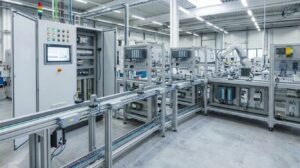
The headline number is the interval between signature and first output. It is genuinely fast, but it is not a greenfield factory built in 150 days. The Huizhou subsidiary was registered on 30 June at an address inside Qunyi Smart Manufacturing Industrial Park, in building E1-1. That is an existing multi-tenant industrial park building, which points to fit-out work between June and October rather than new construction: power distribution, compressed air, lighting, assembly fixtures, conveyor or AGV routes, end-of-line test and the calibration area that any L4 vehicle needs before it can be shipped.
That distinction matters for anyone reading the announcement as a demand signal. A greenfield plant creates a large, front-loaded construction and equipment order. A fit-out creates a smaller, faster, more modular order: cells, stations, test benches and material handling, much of it bought from integrators rather than specified directly by the vehicle maker. It also means the physical constraint on output is unlikely to be the building. For low-speed cargo vehicles, the usual bottlenecks are chassis supply, wiring harness quality, sensor calibration capacity and end-of-line ADAS validation, because every vehicle needs its lidar, camera and ultrasonic set aligned and verified before delivery.
The RMB 1.6 billion figure should also be read as a programme, not a purchase order. Phase one is RMB 600 million and phase two RMB 1 billion, and neither the phase-two schedule nor the split between buildings, equipment and working capital has been published. Local reporting in May described the project as a headquarters combining R&D, intelligent manufacturing, scenario demonstration and regional operations. A headquarters of that kind spends most of its money on people and equipment over several years, not on a single assembly hall.
What the line is being set up to build
The only vehicle Xingshen has publicly tied to volume production is the T6, developed with Geely Farizon and sold under the Farizon Robovan brand. It is a purpose-built low-speed cargo platform rather than a converted van, and its published numbers explain why the segment is moving from retrofit kits to OEM lines.
| Parameter | Published figure | What it implies for the line |
|---|---|---|
| Cargo box | About 6 cubic metres | Large body panels and a volume assembly sequence; panel fit and sealing are visible quality items |
| Payload | 1 tonne | Chassis, axle and brake specification closer to a light truck than a delivery robot |
| Range | About 180 to 200 km loaded, depending on source and cycle | Battery pack size drives charging infrastructure at depots, not just the line |
| Charging | 30 minutes of DC fast charging adds about 100 km | End-of-line test needs a charged pack and a charging bay per shift |
| Steering | Four-wheel steering | Additional actuator, sensor and alignment steps; a calibration station, not a static toe check |
| Wading depth | 400 mm | Sealing and ingress testing become line quality gates |
| Design life | More than 400,000 km | Durability targets push reliability and torque-trace requirements onto suppliers |
| Perception | Dual wide-angle lidar plus camera and ultrasonic sensors, 360-degree coverage | Sensor cleaning, alignment and EOL calibration are capacity constraints |
| Top speed | Up to 60 km/h as a vehicle | Public-road operation in Huizhou is capped far below this; see the policy table below |
Two cautions. First, these are published marketing and press figures for the T6, not a homologation document, and range varies with load, temperature and route. Second, none of this confirms that the Huizhou plant will assemble the T6. Xingshen's own product page lists the P3, T6, T6 Pro and T6S, and the company has described the Huizhou site only as complete-vehicle assembly for unmanned logistics vehicles. A plant can assemble a partner's vehicle, its own vehicle, or both on the same line. Until the company names the models, capacity planning is guesswork.
The order book that justifies the line
What is not in doubt is that Xingshen has converted its L4 stack into volume commitments, mostly through partnerships rather than direct sales. The sequence below is drawn from company announcements and partner statements, and each number should be treated as a commitment rather than a shipped unit.
| Date | Counterparty | Commitment |
|---|---|---|
| 2025 | Multiple commercial vehicle OEMs | More than 100,000 L4 mass-production orders claimed; solutions deployed in over 300 cities with more than 12 million parcels delivered |
| 7 January 2026 | Geely Farizon | First phase of 5,000 jointly developed car-grade unmanned vehicles, deployed through Xingshen's Mashangdao operating brand |
| January 2026 | Market launch of T6 | 26,000 orders announced at launch across several logistics customers |
| May 2026 | J&T Express and Mashangdao | Plan for 10,000 units over three years in a national unmanned delivery network |
| 18 June 2026 | Geely Farizon and Cao Cao Mobility | 100,000 T6 vehicles deployed cumulatively by 2030 |
| September 2026 | Changsha operating fleet | More than 200 vehicles in service, targeting 500 by the end of 2026 and 1,500 by 2027 |
The operating data behind those commitments is more useful than the order headline. Xingshen has said its global fleet exceeds 2,000 vehicles with close to 90 million km of real driving, and that unmanned operation cuts the cost per parcel from roughly RMB 0.50 to RMB 0.20 or 0.30, a reduction of about 30 percent. Both are company figures and neither has been independently audited, but the direction is consistent with depot economics: a low-speed electric cargo vehicle avoids driver cost, and the remaining costs are electricity, parking, insurance, remote supervision and maintenance. Those last two are where industrial spare parts enter the picture.
Huizhou's rulebook decides what leaves the yard
The plant is in Huizhou, and Huizhou has just written the rules for the vehicles it builds. Four municipal departments issued trial rules for functional unmanned vehicle road testing and demonstration on 7 August 2026, effective from 7 September 2026 to 31 December 2028. A follow-up notice in September made the permit requirement explicit: no approval, no public road.
| Requirement | Threshold in the Huizhou rules | Practical consequence |
|---|---|---|
| Vehicle class | Low-speed electric wheeled vehicle without a driver, used for delivery, sanitation, patrol and similar tasks | Passenger-carrying robotaxis fall outside this regime |
| Design speed | 45 km/h or less | A 60 km/h-capable platform must be configured and documented to the lower limit |
| Public-road speed | 25 km/h or less | Route planning and scheduling assume 25 km/h, not the vehicle maximum |
| Insurance | At least RMB 5 million | Fleet operating cost includes a policy per vehicle, not per route |
| Road test | 240 hours and 1,000 km, no commercial work or fees | Test vehicles cannot earn revenue while accumulating the requirement |
| Demonstration | 1,200 hours and 5,000 km, commercial operation allowed on approved routes | Revenue service needs a longer accumulation than testing |
| Vehicle code | HZ-prefixed code issued with the notice | Fleet identity is municipal, not national; codes do not transfer between cities |
| Enforcement | Unapproved operation handled by traffic police; 12-month ban on applying after a violation | A compliance failure costs a year of market access, not a fine |
This is the part of the story that a factory opening tends to obscure. Assembly capacity is not the same as operating permission. Each route and each vehicle needs approval, and the September notice makes clear that road testing and demonstration are different permits with different commercial rights. For Xingshen, the Huizhou plant is also a local-content argument: a municipal government that hosts the factory, the R&D centre and the demonstration zone has a stronger reason to approve routes for the vehicles built there. That is how these deals usually work, and it is also why the "whole-domain unmanned" language in the announcement matters more than the ribbon cutting.
Zhongkai is buying a cluster, not a factory
The signings on the same afternoon show the strategy. Nationz brings security chips and microcontrollers, West Lake Robotics brings embodied AI, Guotan Semiconductor brings power devices, and Yuanyin Technology adds another intelligent manufacturing project. The zone says it hosts more than 100 AI and robotics manufacturers, about 45 percent of Huizhou's total, on top of a 2025 industrial output of RMB 403.7 billion. In April 2026 it published a ten-point AI industry policy, and in September it closed the first RMB 600 million AI venture fund, with a ten-year life and a mandate to invest early and in hardware.
The competitive picture inside Huizhou is just as important. Desay SV's 川行致远 already operates more than 100 unmanned delivery vehicles in the city, holds more than 100 test plates and has opened over 1,000 operating and commissioning routes. Xingshen is not entering an empty market; it is entering a market where the local incumbent has a multi-year head start on permits, depot locations and municipal relationships. Cluster density helps with suppliers and hiring. It does not create road space.
What this changes for automation and MRO buyers
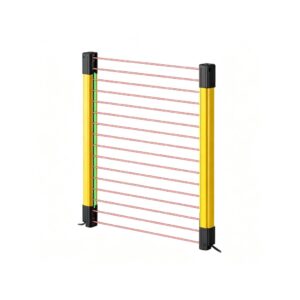
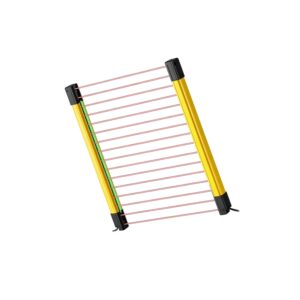
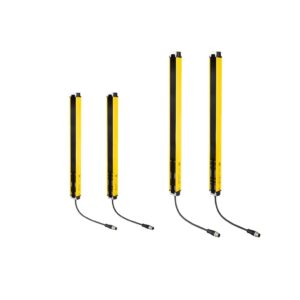
For anyone selling into the plant or into the depots it supplies, the useful question is not how large the investment headline is. It is which parts of the operation are already standardised enough to specify now. A low-speed cargo vehicle assembly line is still an assembly line: PLC-controlled stations, servo axes for handling and tightening, safety light curtains around the cells, managed industrial Ethernet between stations, 24 V DC power distribution, encoders on conveyors and positioners, and contactors and breakers in every panel. End-of-line calibration adds precision motion, vision and test-bench power supplies. Depot operations add conveyors, lifts, charging cabinets and the same class of control hardware.
None of that requires a new supplier category. It requires the usual industrial electrical bill of materials, available at short lead time and in the ratings the integrator specifies. That is the layer we cover: PLC CPU modules such as the Siemens 6ES7212-1AE40-0XB0 CPU 1212C, servo drives including the Mitsubishi MR-J3-700T-ED 7 kW amplifier, Type 4 safety light curtains for cell guarding, and managed Ethernet switches for the line network. Panel power comes from units such as the SD-802F 24 V DC supply, with drives and motors grouped under drives and motors.
The second wave of demand is after-sales. A fleet of 2,000 vehicles running 90 million km accumulates wear on brakes, steering actuators, cooling fans, sensors and charging contacts, and every depot needs a spares kit. That is a different order pattern from a project bill of materials: smaller quantities, faster turnaround, and a premium on exact model matching. It is also the pattern our catalogue is built for, with brand indexes for Mitsubishi, Siemens, ABB, Schneider Electric and Yaskawa.
What to watch next
- Capacity and model mix. The first disclosure to look for is an annual output figure and a named vehicle. Without both, the plant could be anything from a pilot build shop to a 20,000-unit line.
- Phase-two start. The RMB 1 billion second phase is the clearest signal that demand has outrun the first-phase building. A ground-breaking date, not a speech, is the trigger.
- Route approvals. Watch the Huizhou AI and robotics bureau for HZ-coded demonstration notices that name Xingshen vehicles. That is the real start of local revenue service.
- Supplier localisation. A cluster play only pays off if harnesses, structural parts, battery packs and sensor brackets move within a short radius. Procurement announcements will show whether that is happening.
- Full-production wording. The company has been careful to say "after full production" for the complete-vehicle scope. Until that phrase is replaced by a date and a number, treat output as ramping, not rated.
Frequently asked questions
Did the Xingshen Huizhou plant actually start production?
Yes, first-phase production began on 29 October 2026 at Qunyi Industrial Park in the Zhongkai High-tech Zone. Official accounts describe the event as a production launch and say the plant will assemble complete unmanned logistics vehicles once fully operational. Full production has not been dated.
How much is Xingshen investing in Huizhou?
About RMB 1.6 billion in total, split into RMB 600 million for phase one and RMB 1 billion for phase two. The figures are planned investment, not confirmed spending, and no phase-two schedule has been published.
Which vehicles will the Huizhou plant build?
Not stated. The company says complete unmanned logistics vehicles, and the only model it has linked to volume production is the T6 developed with Geely Farizon. Xingshen also lists the P3, T6 Pro and T6S on its own site, so the plant could build partner vehicles, its own vehicles or both.
Can these vehicles drive on public roads in Huizhou?
Only with approval. Huizhou requires a road test or demonstration notice, a vehicle code and at least RMB 5 million of insurance, and caps public-road operation at 25 km/h. Unapproved operation can lead to a 12-month ban on applying again.
Does Xingshen manufacture the T6, or does Geely Farizon?
Geely Farizon builds the T6 on its own chassis and sells it as a Robovan. Xingshen supplies the L4 driving stack and, through its Mashangdao brand, operates fleets. The Huizhou plant is a separate Xingshen manufacturing site, and its product assignment is not public.
Is the Huizhou plant a customer for automation suppliers?
Indirectly and over time. A first-phase fit-out buys cells, conveyors, test benches, calibration equipment and panel hardware through integrators. The larger recurring demand is depot and fleet maintenance, which needs brakes, actuators, sensors, fans, power supplies and control spares in small quantities at short notice.
Do you stock parts for this kind of assembly line?
We stock industrial control and electrical spares rather than vehicle-specific components. The range covers PLC modules, servo drives, safety light curtains, managed switches, 24 V power supplies, encoders, contactors and breakers from Mitsubishi, Siemens, ABB, Schneider Electric, Allen-Bradley and Yaskawa, and we can cross-reference a line item to a stocked equivalent.
Sources
The event date, venue, investment, signing date, production scope and the list of co-signings come from the Southern Metropolis Daily report republished on 30 October 2026 and from the Huizhou municipal government release of 31 May 2026 on the project signing. The phase split of RMB 600 million and RMB 1 billion, the Qunyi Industrial Park location and the subsidiary details come from Huizhou Daily reporting and the company registration record for Xingshen Intelligent (Huizhou) Robotics Co., Ltd. The T6 specifications are from Geely Farizon launch material as reported by CVNews and Sohu in January 2026, with the lidar configuration from Seyond in June 2026. Order and fleet figures are company announcements: the 5,000-unit Farizon agreement of 7 January 2026, the 26,000 launch orders, the Cao Cao 100,000-unit plan of 18 June 2026, the J&T three-year plan, and the Changsha fleet targets reported in September 2026. Huizhou rule thresholds are from the implementation rules issued on 7 August 2026 and the municipal notice of 19 September 2026. Zhongkai cluster figures are from Huizhou Daily reporting on the RMB 600 million fund in September 2026 and the zone's own 2025 output figure. The ASPICE 4.0 CL2 assessment is reported from the company announcement of August 2026. Figures described in the text as company claims have not been independently audited.
Talk to us
If you are specifying the electrical bill of materials for an assembly cell, an end-of-line test bench or a depot maintenance store, send us the model, the rating and the quantity. Our drives and motors range covers servo and general-purpose motion, the CPU modules category covers Siemens and Mitsubishi control hardware, and the power supplies, safety and protection and cables and connectors categories cover the panel around them. For motion replacement, the Yaskawa SGDH-08AE-S 0.8 kW amplifier and the ABB ACS880-01-156A-5 wall-mounted drive are both stocked classes we handle regularly, alongside the Siemens SINAMICS V20 2.2 kW, the Allen-Bradley PowerFlex 525 7.5 kW and the Schneider Altivar ATV320 5.5 kW. Browse by manufacturer through Mitsubishi, Siemens, ABB, Schneider Electric, Allen-Bradley and Yaskawa, or read how the same supplier base is moving in our pieces on the Mitsubishi Electric and ABB low-voltage joint venture and the diverging strategies at Siemens, Schneider Electric and ABB.
Looking for L4?
Browse genuine L4 units, specifications, and pricing — or request a quote from our automation specialists.
View L4 Products & Get a Quote →