On 27 October 2026 Estun Automation signed a property-rights transaction contract to take the remaining 19.4574 percent of Estun Intelligent Technology (Jiangsu) Co., Ltd. that it did not already own, at a consideration of RMB 210.60 million — exactly the floor price published when the stake was listed on the Shanghai United Assets and Equity Exchange on 18 September 2026. The buy-in lifts Estun-held control of the line builder from 50.1506 percent to 69.608 percent, which is why most coverage reports the round figure of 69.61 percent. If you operate one of the more than one hundred automated lines that this subsidiary has delivered — lithium-battery cell and module lines, energy-storage assembly, new-energy-vehicle structures and sheet-metal cells — the practical answer is much narrower than the headline. The legal entity you contracted with does not change. Its registered business scope already covers manufacturing and sales of industrial automatic control devices, intelligent control system integration, mechanical equipment sales and maintenance of electronic and mechanical equipment. No employee resettlement is involved, and claims and debts stay with the target company. What changes is who owns the margin, who approves the next quotation, and how deliberately the parent intends to use the integrator as a landing pad for its own controllers, servo drives and robots.
Key takeaways
- Only one of three tranches is signed. The 27 October contract covers the 19.4574 percent held by the national manufacturing-transition fund. Two further tranches — 3.7834 percent and 21.6193 percent — were disclosed as planned but not executed on that date, so 69.608 percent is a milestone, not the end state.
- The stated destination is 95.0107 percent, not 100 percent. If all three tranches close, Estun-held control rises to 95.0107 percent. A Nanjing-based holding platform (3.5841 percent) and one individual shareholder (1.4052 percent) remain outside the buy-in.
- Signing is not completion. A RMB 63.18 million deposit (30 percent) converts into the price, the RMB 147.42 million balance falls due within five working days, handover is due within 30 working days, and the industrial-commercial registration change is due within 60 working days after the transaction certificate. The company lists that registration as an open risk.
- The price is 2.00 times audited book equity. Attributable net assets at the 31 December 2025 base date were RMB 541.03 million; the market-approach appraisal put full equity at RMB 1,017.95 million, up 88.15 percent. The RMB 210.60 million floor is a further 6.3 percent above the pro-rata share of that appraisal.
- The target was loss-making on both disclosed periods. It recorded a net loss of RMB 5.12 million on revenue of RMB 565.92 million in 2025, and a net loss of RMB 1.31 million on revenue of RMB 299.50 million in the first half of 2026 — while its total liabilities fell 23.4 percent.
- The sellers are on a clock. The three funds holding 44.8601 percent between them have registered terms that expire on 30 March 2028, 17 November 2029 and 23 December 2030. Exchange listings with published floor prices are how a state-linked fund closes a position without negotiating a discount.
What was signed on 27 October, and what was not
The disclosure is unusually concrete for a Chinese buy-in, because the stake was sold through a property-rights exchange rather than by private negotiation. That matters for procurement records: the terms below are the ones to cite when you ask a supplier who is accountable for a line built in Gaochun.
| Term disclosed | Position on 27 October 2026 |
|---|---|
| Instrument | Property-rights transaction contract, signed following an organised-signing notice dated 23 October 2026 |
| Stake acquired | 19.4574 percent of Estun Intelligent Technology (Jiangsu) Co., Ltd. |
| Consideration | RMB 210.60 million (published as RMB 21,060 wan), equal to the exchange floor price |
| Route to market | Public listing on the Shanghai United Assets and Equity Exchange from 18 September 2026; one qualified intent transferee |
| Payment | Deposit of RMB 63.18 million (30 percent) converts to purchase price; RMB 147.42 million balance within five working days |
| Valuation base date | 31 December 2025 |
| Handover and registration | Handover within 30 working days; registration change within 60 working days after the transaction certificate |
| Late payment | Default interest of 0.5 per thousand of the overdue amount per day; the seller may terminate after 30 days of delay |
| People | No employee resettlement is involved |
| Creditors and contracts | Claims and debts remain with the target company; no asset disposal is part of the transaction |
| Costs | Each side bears its own transaction costs |
| Governing law and forum | Law of the People's Republic of China; disputes to the court where the target is located |
| Related party? Restructuring? | Not a related-party transaction and not a major asset restructuring; approved within board authority; funded with the company's own funds |
| Open risks named by the company | The registration change for tranche A is not yet done; tranches B and C were still unsigned at the reporting date |
Three tranches, three seller clocks
Reading only the headline produces the wrong picture. The plan announced on 23 September 2026 was to acquire 44.8601 percent in total from three institutional holders, taking control to 95.0107 percent. The October progress announcement confirms one tranche and explicitly states that the other two were not signed. The three sellers also have different exit mechanics: two positions went through the exchange with floor prices, and the largest one is a negotiated transfer.
| Tranche | Seller (our rendering of the disclosed name) | Stake | Disclosed price basis | Status at 27 October | Registered term of the seller |
|---|---|---|---|---|---|
| A | National manufacturing transformation and upgrading fund | 19.4574% | RMB 210.60 million, exchange floor | Contract signed | Expires 17 November 2029 |
| B | State-owned enterprise mixed-ownership reform fund | 3.7834% | RMB 40.25 million floor | Not signed | Expires 23 December 2030 |
| C | General Technology high-end equipment fund (Tongxiang partnership) | 21.6193% | Negotiated, no floor published | Not signed | Expires 30 March 2028 |
| All three closed | 44.8601% | Estun-held control moves from 50.1506% to 95.0107% | |||
Two ownership chains are worth following here, because they explain the sequencing. The national manufacturing fund is not simply selling its own 19.4574 percent: it also holds 30.0 percent of the Tongxiang partnership that owns tranche C. Counting both, its economic interest in the line builder is about 25.94 percent — the single largest non-Estun position, and the one tranche A begins to unwind. The mixed-ownership reform fund appears directly in tranche B and indirectly through 18.0 percent of the same Tongxiang partnership, which puts roughly 7.67 percent of the target behind that one fund. Our figures here are derived from the shareholder tables in the announcements; they are not separately disclosed totals.
What the subsidiary actually is
Estun Intelligent Technology (Jiangsu) Co., Ltd. was established on 19 July 2022 in the Gaochun District economic development zone of Nanjing, with registered and paid-in capital of RMB 362.71 million. Its unified social credit code — 91320118MABRLN9A80 — is the number that matters to you if you hold a purchase order, a warranty or a service agreement with it, because the buy-in does not touch it.
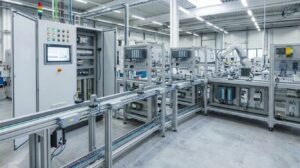
The disclosed business is turnkey intelligent manufacturing lines in four segments: lithium battery, energy storage, new-energy vehicles and sheet metal. Cumulative deliveries exceed one hundred lines. Read alongside the registered scope, the company is simultaneously three things a parts buyer normally has to chase separately: a systems integrator that owns the line design, a seller of automatic-control devices and electronic components, and a maintenance provider for electronic and mechanical equipment. Its scope explicitly lists manufacturing and sales of industrial automatic control system devices, intelligent control system integration, intelligent basic manufacturing equipment, manufacturing and wholesale and retail of electronic components, research and sales of mechanical equipment, maintenance of electronic and mechanical equipment (excluding special equipment), sales of new-energy-vehicle production test equipment, and import and export.
| Measure (RMB million) | FY2025, audited | H1 2026, unaudited |
|---|---|---|
| Revenue | 565.92 | 299.50 |
| Net profit | -5.12 | -1.31 |
| Net profit attributable to the equity holders | -5.59 | -3.26 |
| Total assets | 1,185.17 | 1,041.92 |
| Net assets | 574.37 | 574.06 |
| Net assets attributable to equity holders | 541.03 | 538.27 |
| Total liabilities (derived: assets less net assets) | 610.80 | 467.86 |
The shape of that table is the real story about the operating business. Revenue in the first half of 2026 annualises below the prior full year, the company is still slightly loss-making at both dates, and the losses attributable to equity holders are larger than total net losses — which is what minority-level results look like when a holding platform and individuals sit below the parent. Yet total liabilities fell by RMB 142.94 million, or 23.4 percent, in six months while net assets held flat. In plain terms, the line builder delevered rather than shrank: less borrowed working capital, roughly the same equity. For an owner of installed capacity that is a healthier signal than the loss line, and it is also why the parent could argue for control at a premium.
The price, in one tight paragraph
Base date 31 December 2025; appraisal report reference Zhonglian Ping Bao Zi [2026] No. 2360; market approach; full equity valued at RMB 1,017.95 million against audited attributable net assets of RMB 541.03 million, an increase of RMB 476.92 million or 88.15 percent. Tranche A therefore carries a pro-rata appraised value of RMB 198.07 million, so the RMB 210.60 million exchange floor sits 6.3 percent above its own appraisal share and 2.00 times audited book for that stake — because an exchange floor cannot be set below the filed appraisal. Against the parent, the number reads as follows: the buy-in equals about 1.31 times the RMB 161.33 million the group reported as attributable net profit for the first half of 2026, about three times the RMB 70.0 million it reported on a recurring basis for the same period, and about 11.5 percent of the RMB 1.824 billion of cash the group held at 30 June 2026. Add the RMB 487.10 million paid the same year to take the collaborative and embodied-robotics subsidiary Estun Kuo Zhuo to 100 percent through two wholly-owned arms, and 2026 cash committed to consolidating partially owned subsidiaries is on the order of RMB 697.70 million. Those combinations are ours, not disclosed figures; the four inputs are all from the company's own filings.
What changes for a plant already running hardware from this group
This is the section a reliability manager cares about, so it is worth separating the disclosed mechanics from the incentives they create.
| Area | Position on the disclosed terms | What to watch |
|---|---|---|
| Contracting entity | Unchanged; same name, same unified social credit code, same registered address in Gaochun | No action required on existing purchase orders, warranties or integration contracts |
| Claims, debts, obligations | Stay with the target company; no asset disposal in the transaction | Continuity is contractual, not discretionary — cite the announcement if a service desk claims a reorganisation reset terms |
| People and know-how | No employee resettlement is involved | Retention of the specific commissioning engineers on your line is not covered by disclosure |
| Parts and service channel | Registered scope already covers device sales, component wholesale and equipment maintenance | The same legal entity is integrator, parts channel and service provider; consolidation gives the parent a reason to route both through it |
| Ownership of the plant | Estun-held control rises to 69.608 percent; the entity is consolidated either way | Higher control means fewer minority veto points on pricing and investment decisions |
| Minority interest | Two institutional tranches and 4.9893 percent of small holders remain outside tranche A | Further tranches would change the picture again; the plan of record is 95.0107 percent |
| Legal completion | Pending registration change, up to 60 working days after the transaction certificate | Until registration, the share register and the public record disagree — ask for the certificate if you need certainty |
The continuity argument is the strong one
Compare the two corporate actions the company took in 2026, because they move in opposite directions and buyers feel the difference. On 23 June 2026 Estun announced the absorption merger of its wholly-owned subsidiary Nanjing Estun Automatic Control Technology Co., Ltd.: on completion that entity's legal personality is cancelled, and all of its business, assets, claims, debts and other rights and obligations pass to the listed company itself. On 27 October 2026 it bought equity in a subsidiary that keeps its legal personality, its registration number and its obligations. One is simplification by deletion, the other simplification by ownership. If you are a plant owner, the practical consequence is that your counterparty never changes in this transaction — only the entity standing behind it.
The parts question is the interesting one
The announcements state the purpose plainly: consolidating the line builder gives the group a benchmark case for landing its own automation core components and robot products in each segment market — the disclosed wording translates as building industry technology benchmarks so that the parent's core components and robots get specified into the segments where the integrator already delivers. That is the sentence to read if you buy spare parts. A wholly controlled line builder is a stronger channel for the parent's own servo drives, controllers and robots, and a weaker one for third-party components that were previously chosen on merit. Estun already sells the parts class most at risk of being displaced inside its own lines — the group's core-component layer is servo systems, motion control and encoders, which is exactly the population that ages out of a line years before the line itself does. For an owner-operator, that argues for locking in cross-compatible spares and documented equivalents while the counterparty is stable and the incentive to substitute is new.
Why three state-linked funds are selling at once
Nothing in the disclosure suggests distress at the target. The forcing constraint sits at the sellers. Each of the three institutional holders has a fixed registered term, and the earliest — the Tongxiang partnership that owns tranche C — expires on 30 March 2028, less than eighteen months away. A fund with an expiry date and a state-linked ownership chain faces two ways out: a negotiated transfer that has to survive audit, or an exchange listing with a published floor. The parent is the only buyer who can pay an appraisal-plus price without a diligence process, because it already sees the books; the 2025 audit, the 2026 interim numbers and the appraisal were all in hand before the listing went up. That is why the floor landed where it did, and why a second and third tranche are more likely to be completed by negotiation than by a competitive auction.
The 2026 pattern: fewer legal entities, one balance sheet
Put the three 2026 actions in order and the strategy is legible. June: announce the absorption merger of the automatic-control subsidiary, so its obligations merge into the listed company. August and September: pay RMB 487.10 million in cash to bring the collaborative and embodied-robotics company to 100 percent through two wholly-owned arms, with a performance commitment covering cumulative revenue of not less than RMB 620 million across mid-2026 through 2029 — a related-party transaction, because that target sat under the controlling shareholder. October: start buying back the line builder, this time not a related-party transaction, funded with own funds and approved inside board authority. Taken together, the group is deleting minority layers, absorbing entities whose obligations it can then carry at the top, and paying appraisal premiums to own the channels that specify and service automation hardware. For anyone maintaining equipment inside that ecosystem, ownership consolidation is the variable to watch — not because service will collapse, but because the definition of an approved spare part is about to be written by someone with a manufacturing interest in the answer.
A checklist for the next 60 working days
- Confirm the counterparty on your line contract is the entity with unified social credit code 91320118MABRLN9A80, and keep the contract referencing that number rather than a trading name.
- Ask the supplier for the property-rights transaction certificate and the registration-change receipt before accepting any change to service terms or pricing.
- Ask, in writing, whether the 2026 consolidation changes authorised service partners, spare-parts pricing tiers, or the response times in your maintenance agreement.
- Rebuild your bill of materials down to the component layer: drives, encoders, motion controllers, safety inputs, network interfaces and power supplies, each with manufacturer and part number.
- Identify which of those components are single-source through the integrator and price a stocked alternative now, while lead times are the only constraint.
- Photograph and archive the drive and controller nameplates on axes that are out of production; the appraisal premium says these lines are being bought for what they will specify next, not for what they were built from.
- Record firmware, parameter sets and network topology for every controller on the line, because consolidation increases the odds of a migration to a house standard.
- Treat 69.608 percent as provisional. If tranches B and C close at 95.0107 percent, the incentive to route components through the parent changes materially.
Where our catalogue fits
Straight answer first: we do not list Estun SKUs. We are not an authorised Estun distributor, and we will not invent a part number for a controller or drive we cannot verify, so nothing below is offered as a like-for-like Estun replacement. What we do stock is the component population those lines are built from, in brands whose documentation and cross-reference data are stable enough to plan a spare-parts holding around. That matters more than usual here, because consolidation tends to narrow who is allowed to quote.
For the axis layer, servo packages are where most unplanned downtime in a battery or storage line actually lives. Our Kinetix 6200 multi-axis servo drive, Kinetix 350 servo drive with safe torque off and Kinetix 300 EtherNet/IP servo drive cover the single-axis to multi-axis range, and safe-torque-off variants are the ones to check first on cells where guarding was retrofitted after commissioning. On the motor side we list Mitsubishi HG-KR23J, HG-KR73J (0.75 kW, IP65, 22-bit encoder), HG-MR43B ultra-low-inertia and HG-MR13, the low-inertia family that shows up repeatedly in high-speed pick-and-place and cell-transfer stations. For amplifier-level spares on 400 V class equipment, our FANUC A06B-6124-H104, A06B-6150-H045 (50 kW, 400-480 VAC), A06B-6100-H001 six-axis amplifier, A06B-6096-H116 and the matching A06B-6087-H137 power converter are stocked as modules, which is how they fail in practice — one axis at a time, usually after a supply-side event rather than a wear-out.
For process and conveyor drives, the ABB ACS880-01-156A-5 wall-mounted drive and the ACS880-01-430A-3 at 250 kW bracket the range most sheet-metal and module-transfer cells actually use, the ABB FENA-11 fieldbus kit for the ACS880 covers the network side, and the KEB F5 Combivert axis drive (09F5B1B-2B0A, 1.5 kW, 7 A, 16 kHz) is the kind of compact axis unit found on winding and tension stages. The FANUC VFS15-4055PL-W1 7.5 hp inverter sits in the same purchasing decision for small conveyor and pump loads.
For the control and communications layer — the parts that age out quietly — we list the Schneider TSX Micro 37 21 101 base controller with its TSX ETY 4103 Ethernet TCP/IP module and TSX PSY 5500M power supply, the Modicon 140-NOE-771-00C Ethernet module, and on the GE side the RX3i PACSystems IC695PBS301 Profibus slave and the VersaMax IC200GBI001 Genius interface unit. Safety inputs are the category with the shortest honest lead times, so it is worth naming what we carry: the Allen-Bradley 1791DS-IB16 Guard I/O safety input module and the 1794-IJ2 frequency input module for encoder-feedback stations on presses and winders. For 24 V plant power and specialist control, see the ABB SD832 DIN-rail supply, the Honeywell 05701-A-0284 catalytic sensor driver for gas-detection loops, and the Tricon 4351B four-serial-port communication module for legacy safety-critical racks.
Related coverage on this site that bears on the same purchasing decisions: Keruisi opens its Shanghai IPO, a look at a direct-drive machine-tool maker that builds its own CNC — the same vertical-integration logic, from the machine side; the Mengying AMHS acquisition, where a 615 percent premium and two motion-control patents show what minority buy-ins price like when the buyer is strategic; Mitsubishi Electric and ABB rearranging low-voltage distribution, the mirror case of a Japanese-European consolidation; the Nidec Commander S extension to 11 kW and the Omron C6 servo launch for what is arriving in the light-duty drive class; Yaskawa's AI welding robot in production for the joining-cell case that overlaps sheet-metal lines; and on the risk side, CISA's warning on legacy PLCs and spare parts plus the PHP2Shell findings on industrial web interfaces, because consolidation and remote-service portals travel together. For the wider parts picture, passive-component lead times stretching to 25 weeks explains why the maintenance and component-sales clause in a scope description is worth more than it looks.
Everything above is a subset of the live catalogue. Line owners comparing a control retrofit may also want the industry pages, and industry news and the blog index carry the rest of our consolidation and component coverage.
Frequently asked questions
What exactly did Estun announce on 27 October 2026?
Estun Automation signed a property-rights transaction contract to buy the 19.4574 percent stake in Estun Intelligent Technology (Jiangsu) Co., Ltd. that it did not already own, for RMB 210.60 million. Held control rises from 50.1506 percent to 69.608 percent. The stake came from the national manufacturing transformation and upgrading fund through a listing on the Shanghai United Assets and Equity Exchange that opened on 18 September 2026, and the price paid equals the published floor.
Is the acquisition finished?
No. The contract is signed, but the company lists the industrial and commercial registration change as a remaining risk, with a deadline of 60 working days after it receives the transaction certificate. Payment runs in two steps: a RMB 63.18 million deposit that converts into the purchase price, and a RMB 147.42 million balance due within five working days. Handover is due within 30 working days.
Does Estun now own the whole subsidiary?
Not yet, and not fully under the announced plan. This contract covers one of three tranches. A further 3.7834 percent held by the mixed-ownership reform fund and 21.6193 percent held by the General Technology high-end equipment fund in Tongxiang were disclosed as planned but unsigned at the reporting date. If all three close, held control reaches 95.0107 percent. A Nanjing holding platform with 3.5841 percent and one individual shareholder with 1.4052 percent stay outside the buy-in.
Does the deal change who services an existing production line?
Nothing in the disclosed terms changes it. The target keeps its legal personality, its name and its unified social credit code, 91320118MABRLN9A80. The announcement states that no employee resettlement is involved and that claims and debts remain with the target company. Existing purchase orders and warranties therefore run against the same counterparty, and the registered scope of that entity already covers intelligent control system integration, sales of automatic-control devices and maintenance of electronic and mechanical equipment.
Why pay 2.00 times book equity for a loss-making subsidiary?
Two mechanics are visible in the disclosure. A floor price on a state exchange listing cannot be set below the filed appraisal, and that appraisal valued full equity 88.15 percent above audited attributable book value, at RMB 1,017.95 million against RMB 541.03 million. And the buyer is paying for a channel rather than for current earnings: the subsidiary has delivered more than one hundred intelligent lines in lithium battery, energy storage, new-energy vehicle and sheet-metal manufacturing, which is where the parent wants its own servo drives, motion controllers and robots specified.
Can you supply Estun spare parts?
No. We are not an authorised Estun distributor and we do not list Estun part numbers, so we will not quote against them. We stock the component classes those lines are built from, namely servo drives and motors, frequency converters, programmable controllers and communication modules, safety input modules, sensor drivers and 24 volt power supplies, from Allen-Bradley, ABB, FANUC, Mitsubishi, Schneider Electric, GE, KEB, Honeywell and Tricon, and we can cross-reference a nameplate you photograph.
Sources and verification. This article is built from Estun Automation disclosures and their dates, not from secondary summaries. The terms in the first table come from the progress announcement on the acquisition of part of the equity of a held subsidiary, dated 27 October 2026, including the exchange listing date of 18 September 2026, the organised-signing notice of 23 October 2026, the payment schedule, the handover and registration deadlines, and the named remaining risks. The three-tranche structure, seller shareholdings and registered terms, the target company registration data, its business scope, its 2025 audited and 2026 unaudited financial statements, the appraisal report reference and the 88.15 percent valuation increase come from the board announcement on the same transaction. Group-level first-half figures, the 23 June 2026 absorption-merger notice and the RMB 487.10 million robotics buy-in come from the company interim report and its 2026 capital-operation disclosures. Ratios, pro-rata values, liability changes and the aggregated 2026 consolidation spend are our own arithmetic on those disclosed inputs and are labelled as such wherever they appear. Entity and fund names are our renderings of the disclosed Chinese names. We do not hold or trade shares in the companies discussed, and nothing here is investment advice; for procurement and service decisions, rely on the published announcements and your own contracts.