JUNPING Intelligent Manufacturing (STAR Market: 688306) will inject up to €10 million of its own cash into each of two European operating subsidiaries, PIA Automation Bad Neustadt GmbH and PIA Automation Austria GmbH, for a combined ceiling of €20 million. The board approved both resolutions on 29 October 2026 and the company disclosed them in announcement 2026-080 the following morning. The money is booked to capital reserve, not share capital. Registered capital stays where it is, JUNPING keeps 100% of both companies through PIA Automation Holding GmbH, and no shareholder meeting is needed. Outbound investment filing is still pending, and the filing says the final amount will follow the approved quota.
Those mechanics matter more than the headline figure. A capital-reserve injection is what a parent does when a subsidiary needs equity rather than a loan: it repairs the balance sheet, supports the bank guarantees a line builder has to post, and funds project working capital without adding interest. The filing says exactly that — the purpose is to supplement working capital so that projects in hand can be delivered — and it states in the risk section that the transaction adds no production capacity and no industrial land.
Read against the subsidiaries' own numbers, the timing is easier to explain than the marketing language suggests. In the first nine months of 2026, PIA Bad Neustadt lost €3.06 million on €15.02 million of revenue, and its equity was already negative €20.04 million at 30 September. PIA Austria's equity fell from €20.81 million at the end of 2025 to €9.21 million nine months later. This is a recapitalisation of two operating units in a weak European automation market, funded by a group that is growing in Asia and has just raised fresh equity in Shanghai.
Key takeaways
- €20 million, not €20 million of new capacity. Up to €10 million per company, all of it into capital reserve, with registered capital unchanged and no industrial land involved.
- The smaller entity has the bigger balance-sheet problem. PIA Bad Neustadt had €70.4 million of liabilities against €50.4 million of assets at 30 September 2026. Even a full €10 million injection leaves its equity negative.
- Austria swung from profit to loss and lost €11.6 million of equity in nine months. The proposed €10 million roughly matches that erosion.
- Revenue at both units is running well below 2025 levels. Bad Neustadt booked €15.0 million in nine months against €41.0 million for the whole of 2025; Austria booked €49.9 million against €95.7 million.
- This is the second European recapitalisation in 18 months. JUNPING put up to €50 million into PIA Automation Amberg in May 2025, which makes €70 million across three German and Austrian entities.
- The parent is not short of cash. Nine-month revenue was RMB 1.739 billion (+15.3%), new orders RMB 1.683 billion, backlog RMB 2.815 billion, and a RMB 1.01 billion private placement completed in October 2026.
- For anyone buying or maintaining a PIA line, the question is not solvency tomorrow. It is which legal entity signs the contract, what the parent will guarantee in writing, how milestone payments and retention are structured, and where the spare parts and software support sit.
What exactly was announced?
The filing is short and unusually specific. Two resolutions, one per company, passed at the fourth meeting of the third board. Both use the listed company's own funds. Both are capped at €10 million. Both are recorded in capital reserve, so the registered capital of each subsidiary does not change and the ownership chain does not move: JUNPING holds PIA Automation Holding GmbH directly, and the holding company owns both operating units.
Because the amount sits below the board's authorisation limit, the transaction does not go to a shareholder meeting. What it does need is outbound investment approval or filing, which the announcement flags twice: the transaction is subject to approval or record-filing by the relevant authorities, and the actual investment will follow the approved quota. In practice that means the €20 million is a ceiling, not a confirmed transfer, and the timing depends on a regulatory process the company does not control.
| Item | PIA Automation Bad Neustadt GmbH | PIA Automation Austria GmbH |
|---|---|---|
| Seat | Bad Neustadt a. d. Saale, Bavaria, Germany | Registered in Graz; plant in Raaba-Grambach, Styria, Austria |
| Founded | 3 June 2014 | 5 December 2014 |
| Registered capital | €500,000 | €75,000 |
| Proposed injection | Up to €10 million, to capital reserve | Up to €10 million, to capital reserve |
| Revenue, FY2025 | €41.04 million | €95.67 million |
| Revenue, 9M 2026 | €15.02 million | €49.88 million |
| Net result, FY2025 | −€1.78 million | +€0.65 million |
| Net result, 9M 2026 | −€3.06 million | −€2.26 million |
| Total assets, 30 Sep 2026 | €50.39 million | €66.45 million |
| Total liabilities, 30 Sep 2026 | €70.44 million | €57.25 million |
| Net assets, 30 Sep 2026 | −€20.04 million | €9.21 million |
The filing gives nine-month figures without a prior-year nine-month comparative, so the cleanest way to read them is against each unit's full-year 2025 revenue. Bad Neustadt has booked 36.6% of last year's revenue in 75% of the year; Austria has booked 52.1%. Custom automation revenue is lumpy because it follows project milestones rather than shipments, and a single large line can move a quarter. Two units running this far below last year at the same time is still a pattern, not a rounding error.
Is this capacity expansion or balance-sheet repair?
Balance-sheet repair, with a working-capital purpose. The announcement is explicit on three points that rule out an expansion story: the funds supplement working capital, the transaction adds no production capacity, and it requires no new industrial land. Adding a capital-reserve injection on top of that makes the intent unambiguous — the parent is strengthening equity, not buying machines.
The arithmetic explains why. PIA Bad Neustadt ended 2025 with negative net assets of €16.98 million and finished September 2026 at negative €20.04 million, a further deterioration of €3.06 million that matches its nine-month net loss almost exactly. A €10 million injection halves the deficit but does not close it. PIA Austria is a different case: it was solvent and profitable in 2025, then lost €2.26 million in nine months while its equity dropped by €11.60 million. A €10 million injection restores most of that.
Two details in the filings are worth separating. First, a negative equity figure at a German subsidiary is not by itself an insolvency filing. German law tests overindebtedness together with a going-concern prognosis under section 19 of the Insolvency Code, and a parent that commits fresh equity is normally part of that prognosis. Second, the group's exposure to these units is not limited to equity. JUNPING's February 2026 guarantee forecast authorises up to RMB 1.8 billion of guarantees for wholly owned subsidiaries and grandchildren, with no counter-guarantee, covering daily operations, procurement and bank facilities. The €20 million sits inside a much larger support structure.
| Question | What the filing says |
|---|---|
| How much? | Up to €10 million for each company, up to €20 million in total |
| Whose money? | The listed company's own funds, not placement proceeds and not bank debt |
| Where does it go? | Capital reserve; registered capital of both subsidiaries is unchanged |
| Does ownership change? | No. Both remain 100% indirectly held through PIA Automation Holding GmbH |
| Is a shareholder vote needed? | No. The board approved it on 29 October 2026 within its authorisation |
| Is it unconditional? | No. Outbound investment approval or filing is still required, and the final amount follows the approved quota |
| What is it for? | Working capital for projects in hand; no new capacity and no industrial land |
| Does it change consolidation? | No. Both companies stay in the consolidated scope as wholly owned subsidiaries |
Why European line builders need equity, not orders
A custom assembly or test line is one of the hardest cash cycles in industrial supply. The integrator books revenue as milestones are met — design freeze, long-lead component release, build completion, factory acceptance test, site acceptance test, retention release — while paying for drives, robots, conveyors and safety hardware up front. A project that runs twelve to twenty-four months can absorb more working capital than its margin ever returns, and a delay at the customer's plant pushes every later milestone to the right.
That is why a capital-reserve injection is the standard instrument in this sector. It improves the equity ratio that banks and bonding companies look at when they issue performance guarantees, and it does so without the interest burden of a shareholder loan. It is also why the group's European units, not its Chinese ones, are the ones receiving money: the German and Austrian entities carry the long-cycle automotive and e-mobility projects, the local payroll and the guarantee obligations.
The demand side has not helped. VDMA put German robotics and automation revenue at €14.5 billion in 2025, down 10% year on year, with investment restraint across all three sub-sectors. European automotive programmes have been delayed or re-phased rather than cancelled, which is the worst of both worlds for an integrator: the engineering hours are spent, the revenue slips, and the working capital stays out.
How the €20 million fits the wider group
The parent's own nine-month report, published the same day as the capital increase, tells the other half of the story. Revenue reached RMB 1.739 billion, up 15.28%. The net loss attributable to shareholders narrowed 59.82% to RMB 21.83 million, gross margin held at 20.13%, research spending rose 57.70% to RMB 77.45 million, and operating cash flow was positive at RMB 57.37 million. New orders in the nine months totalled RMB 1.683 billion and backlog stood at RMB 2.815 billion.
The order mix is instructive. The company lists a dual-region production line order from a global luxury car brand for plants in China and Europe, a seatbelt retractor line for Southeast Asia, a repeat order from a European customer for a steering wheel assembly and test line, and a pen injector assembly platform for a domestic medical device customer. Europe is still winning orders; the growth and the cash generation are simply not concentrated there.
The group also has fresh equity of its own. Its private placement of 144,020,247 shares at RMB 7.12 was completed in October 2026, raising RMB 1.025 billion gross and RMB 1.011 billion net. The capital increase announcement is careful to say the €20 million comes from the company's own funds rather than from that raise, but the two events in the same month show a group deliberately rebuilding its balance sheet while funding a second growth curve in humanoid robotics through the Ningbo research institute and PIABOT.
| Date | Event | Amount |
|---|---|---|
| May 2025 | Capital increase into PIA Automation Amberg GmbH, also to capital reserve | Up to €50 million |
| February 2026 | Guarantee ceiling approved for wholly owned subsidiaries and grandchildren | Up to RMB 1.8 billion |
| October 2026 | Private placement completed and shares registered | RMB 1.025 billion gross |
| 29–30 October 2026 | Capital increases into PIA Bad Neustadt and PIA Austria | Up to €10 million each |
| 9M 2026 | Group new orders and backlog | RMB 1.683 billion / RMB 2.815 billion |
What this means if you are buying a line from a European integrator
The useful question for a plant engineer or procurement manager is not whether the parent can afford €20 million — it clearly can. It is whether the entity you are contracting with has the equity to carry your project to acceptance, and what happens to spares and support if the project economics turn. Five checks cover most of the exposure.
- Contract with the entity that has the balance sheet, or get a parent guarantee. PIA operates through separate German, Austrian, Chinese, US, Mexican, Croatian and Canadian companies. The entity that quotes may not be the entity with equity. Ask for the legal name, registration number and a support letter or guarantee from PIA Automation Holding GmbH if the operating unit's equity is thin.
- Tie payments to verified milestones and keep retention until SAT. A schedule weighted to design and long-lead release protects the integrator's cash flow, not yours. Progress payments should follow documented FAT results, and retention should survive site acceptance and the ramp-up period.
- Confirm where the control system and software sit. Ask for the PLC and HMI source project files, licence ownership and an escrow arrangement for any proprietary software. This is the item that most often blocks a line transfer or a second-source service contract.
- Agree the spare-parts and obsolescence plan in writing. Get the bill of materials with manufacturer part numbers, identify single-source items, and require a last-time-buy notice for any component going end-of-life. A line builder under cash pressure is more likely to substitute parts than to stock them.
- Watch the milestone language on change orders and delay. In a delayed programme, change orders become the margin. Fix the rate card, the approval path and the liquidated-damages position before the design freeze, not after.
The broader European picture reinforces the point. The same consolidation pressure that produced the Mitsubishi Electric and ABB low-voltage joint venture and the diverging strategies at Siemens, Schneider Electric and ABB is now visible in the integrator tier, where balance sheets rather than order books decide who can carry a two-year project.
Which components carry the delivery risk?
When a line is delayed or re-phased, the components that matter are the ones with long lead times and no drop-in substitute: the controller, the safety chain, the drives and the operator interface. Those are also the parts most likely to be re-specified under cost pressure, which is why the bill of materials deserves the same scrutiny as the commercial terms.
On the control layer, a line built around the S7-1200 family typically uses a compact CPU such as the Siemens CPU 1215C DC/DC/DC with distributed I/O over PROFINET, while a larger automotive cell may sit on a ControlLogix platform with a 1756-L71 Logix5571 processor, 1756-IF16H analog input modules with HART and 1734-AENTR POINT I/O adapters. Older cells still running the Mitsubishi FX3U-128MR are the ones where obsolescence planning matters most.
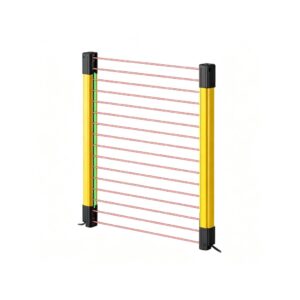
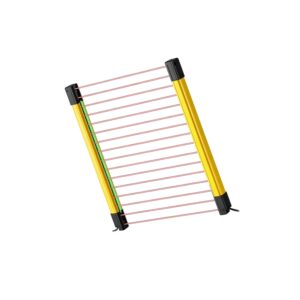
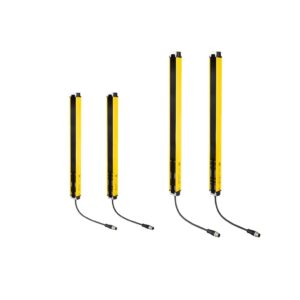
Motion and safety are the next tier. A typical e-drive or battery assembly station pairs a SINAMICS V20 2.2 kW drive or a Schneider ATV320 5.5 kW drive with a Yaskawa SGD7S servo drive on the axis, and guards the cell with a Type 4 safety light curtain and a 3RV motor protection circuit breaker. If the line is being rebuilt rather than replaced, the Mitsubishi MR-J3 amplifier and B&R 8KSL94 servo motor are the kind of matched pairs that are hard to source quickly.
The supporting hardware is where a spare-parts buffer earns its keep:
- Operator interface: a Siemens TP1200 Comfort panel, an Allen-Bradley PanelView Plus 1000 or a legacy GE QuickPanel 12-inch terminal.
- Distributed I/O and communications: an ET 200 16-channel digital input module, a 1734-IE8C analog input module, an IO-Link master for POINT I/O and a Stratix 5700 managed switch.
- Sensing and feedback: a PROFIBUS encoder, a through-beam photoelectric sensor or a Bently Nevada 3300 XL proximity probe on the test stand.
- Power and switching: a 1606-XLS480E 480 W power supply and a 3RT 7 A contactor.
None of this is exotic. It is the ordinary content of a control cabinet, and that is precisely why it is the part that delays a restart when a single module fails and the original supplier has moved to a new generation. Browse the PLC and I/O, VFD drives, servo drives, sensors and instrumentation, HMIs and operator panels and power supplies ranges, or by manufacturer across Siemens, Allen-Bradley, Schneider Electric and Yaskawa.
What to watch next
Three dates decide how this story develops. The first is the outbound investment approval, because until it lands the €20 million is a resolution rather than a transfer. The second is the full-year 2026 report, where the test is simple: does Bad Neustadt's equity move back toward zero, and does Austria stop losing money? The third is order intake at the two units, which the group does not publish separately but which shows up in the consolidated revenue split.
A single capital injection does not fix a demand problem. What it does is buy time for the project pipeline to convert, and it removes the balance-sheet obstacle that can stop a line builder from qualifying for the guarantees a new order requires. For a customer with a line in build, that is the practical difference between a supplier that can finish the job and one that has to renegotiate it.
Frequently asked questions
How much is JUNPING putting into PIA Bad Neustadt and PIA Austria?
Up to €10 million into each company, for a combined ceiling of €20 million. Both amounts come from the listed company's own funds and are booked to capital reserve. The final figure depends on the approved outbound investment quota, so €20 million is a maximum rather than a confirmed transfer.
Is this a capacity expansion?
No. The announcement states that the funds supplement working capital for projects in hand, that the transaction adds no production capacity, and that it requires no new industrial land. Registered capital at both subsidiaries is unchanged, and no new shares are issued to outside investors.
Why does a company with €95 million of revenue need a capital injection?
Revenue and equity are different things in custom automation. PIA Austria earned €95.67 million in 2025 but swung to a €2.26 million loss in the first nine months of 2026 while its equity fell by €11.60 million. PIA Bad Neustadt had negative equity of €20.04 million at 30 September 2026. Project working capital, milestone timing and losses, not order volume, drive that.
Does negative equity mean the subsidiary is insolvent?
Not automatically. German insolvency law assesses overindebtedness together with a going-concern prognosis under section 19 of the Insolvency Code, and a shareholder commitment to inject equity is part of that assessment. Negative equity is still a warning sign, and it is the reason the parent is injecting capital rather than lending it.
Does the transaction change ownership or the consolidated accounts?
No. Both companies remain 100% indirectly owned through PIA Automation Holding GmbH, and both stay inside the consolidated scope. Because the money goes to capital reserve, the registered capital of each subsidiary does not change.
What approvals are still outstanding?
Outbound investment approval or record-filing by the relevant Chinese authorities. The announcement states that the transaction requires this approval and that the actual investment amount will follow the approved quota. No shareholder meeting is required because the amounts fall within the board's authorisation.
What should a buyer of a PIA line check first?
The contracting entity and its equity, a parent support letter or guarantee, milestone-linked payments with retention until site acceptance, ownership of PLC and HMI source files, a bill of materials with manufacturer part numbers, and a written obsolescence and spare-parts plan. Those six items cover most of the exposure a customer carries when an integrator's balance sheet is under strain.
Sources
Primary: JUNPING Intelligent Manufacturing announcement 2026-080, "Announcement on Capital Increase into Wholly Owned Subsidiaries", dated 30 October 2026 (board resolution 29 October 2026), filed on the Shanghai Stock Exchange and available through CNINFO and Eastmoney; announcement 2025-043 of 14 May 2025 on the capital increase into PIA Automation Amberg GmbH; announcement 2026-014 of 12 February 2026 on the 2026 guarantee forecast; the 2026 third-quarter report of 30 October 2026; and the announcement of 23 October 2026 on the completion of the 2025 private placement.
Secondary: PIA Group corporate site (piagroup.com) for the group history, the 13 locations, the installed base of around 8,800 systems and the descriptions of the Bad Neustadt and Grambach plants; VDMA Robotics + Automation 2025 revenue forecast as published in June 2025.
Currency conversions are not applied; all subsidiary figures are shown in euros as filed, and group figures in renminbi as reported. Nine-month 2026 revenue is compared with full-year 2025 revenue only as a directional indicator, because the filing does not provide a prior-year nine-month comparative.
Disclosure: we sell industrial control components, including PLCs, drives, HMIs and sensors, and we are not affiliated with JUNPING, PIA Automation or any of the manufacturers named above. If you are maintaining a line built by PIA or another European integrator and need a cross-reference or a stocked alternative, send us the model number and we will quote it.
Looking for 20?
Browse genuine 20 units, specifications, and pricing — or request a quote from our automation specialists.
View 20 Products & Get a Quote →